Benson Theater renovations bring memories of other area movie houses
Temperatures across Nebraska soared past 100 degrees for third straight day on Aug. 18, 1983. By then, Omaha had had 31 days with temps of 90 or higher that summer — more than double the number from July and August of 1981 and 1982.
The impetus for this column on Omaha’s neighborhood movie houses was the renovation of the Benson Theater to an arts performance space and education center.
But get a bite of this: Those burgers that Dinker’s Bar and Grill on South 29th serves? Their customers are sitting in the old Hanscom Theater.
Ballroom dancing, Ol' Blue Eyes and 'Bubbles' at the Chermot in Omaha
Omaha has been the inspiration for many songs. Check out six of our favorites.
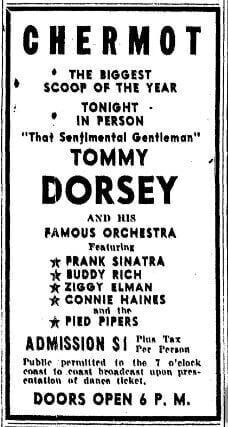
One night only in Omaha, it was Frank Sinatra, Buddy Rich and Tommy Dorsey on stage at the Chermot Ballroom.
Sinatra got only second billing in that 1942 appearance. It was Dorsey and his orchestra who had a weekly Sunday night broadcast on NBC radio. Ol’ Blue Eyes was still a year away from making it big.
New Tower Inn's distinctive look, location made it a popular nightlife destination
A generation of Omahans — and newcomers to the city — likely are unaware that Peony Park, the major amusement spot from the 1930s through 1994, was at 78th and Cass Streets.
Mention the Lazy Leopard, the Bird Cage, the Crest or the Crystal Tree dining rooms, and it signaled that a night on the town was in store at the New Tower Inn.
Omaha’s first motel evolved and sprawled to five blocks along the east side of 78th Street between Dodge and Cass streets. It began as an amenity to Peony Park and took on a life of its own in the early 1960s.
Lisa Schroeder, 15, left and Judy Kinkaid, 16 whirl on Peony Park's "Hurricane" on Aug. 11, 1983.
JAMES R. BURNETT, THE WORLD-HERALD
1969 band shell
Construction of a larger stage in front of the Peony Park band shell took place for the start of Omaha Symphony's Starlight Pops concert series in July 1969.
YANO MELANGAGIO, THE WORLD-HERALD
1992 Flying Bobs
Peony Park employee Bruce Hawkins works on the "Flying Bobs," so it will be ready for the 1992 season opening.
PHIL JOHNSON, THE WORLD-HERALD
From the Archives: Remember Peony Park?
The Hurricane Ride at Peony Park. located at 78th and Cass Streets. An Iowa man fell to his death from this ride in 1988.
ED RATH, THE WORLD-HERALD
1934 beer garden (copy)
The ruins of a new beer dispensary in Peony Park's beer garden, burned to the ground in June 1934 the day it opened. The loss was estimated at $5,000. There was talk of the fire being the result of a "beer war" between two wholesalers over the business, but was considered to be just speculation. The ballroom was saved from the fire by rains that night and opened the next day, serving beverages through a ballroom window.
THE WORLD-HERALD
Remember Peony Park? - 1947 (copy)
An aerial view of Peony Park in 1947 for the "Omaha from the Air" booklet.
JOHN SAVAGE, THE WORLD-HERALD
From the Archives: Remember Peony Park?
Harry Hoover checks the cage on the Skydiver ride on Aug. 4, 1978. A 13-year-old boy fell to his death from the ride in when the cotter pin that held the cage closed came out. Two other children were in the capsule but managed to hang on when the front opened.
PHIL JOHNSON, THE WORLD-HERALD
Peony Park gates (copy)
An undated photo of the gates at Peony Park.
ROBERT MULLEN, THE WORLD-HERALD
1993 amusement park (copy)
Peony Park in 1993. By the next year, the park had been closed for good.
KENT SIEVERS, THE WORLD-HERALD
1987 Waterslide (copy)
Omahan Mary Lynn Riley enjoys a cool, swirling ride on the waterslide at Peony Park in 1987.
CHRIS YOUNG, THE WORLD-HERALD
1978 Trabant
Safety patrol students enjoy a ride on the Trabant at the fifth annual Safety Patrol Day on May 14, 1978.
RICH JANDA, THE WORLD-HERALD
1979 Disco Rondo (copy)
Disco Rondo drew hundreds of teens to Peony's Royal Grove in 1979.
ROBERT TAYLOR, THE WORLD-HERALD
1993 Sky lift
Shirley Duis, left, hugs granddaughter Stephanie Duis and Pam Stone hugs her daughter Melanie after the girls were rescued from the stalled Sky Lift ride in 1983. The ride stalled after riders were jumping and bouncing in their seats and dislodged a cable, causing safety mechanisms to stop the ride.
JEFF BUNDY, THE WORLD-HERALD
2012 auction (copy)
A 25-cent boat ride from Peony Park, part of a huge collection of memorabilia that was auctioned off in December 2012.
JAMES R. BURNETT, THE WORLD-HERALD
1983 Sky Lift
Kathy Thomas of Bellevue and her 3-year-old son, Cameron, try out the Sky Lift at Peony Park on Aug. 11, 1983.
JAMES R. BURNETT, THE WORLD-HERALD
1994 auction (copy)
In this 1994 photo, auctioneer David A. Norton sells off parts of Peony Park after the park's closure. The ride behind him is the Zierer Wave Swinger and sold for $220,000.
PHIL JOHNSON, THE WORLD-HERALD
1985 Galaxy roller coaster
The Galaxy roller coaster gives Peony Park patrons a thrill in June 1985.
MEL EVANS, THE WORLD-HERALD
1958 Wonderland (copy)
Peony Park opened "Wonderland" for the summer season in 1958 plus an "Around the World in 18 Holes" miniature golf course.
ROBERT PASKACH, THE WORLD-HERALD
1972 Polka Days (copy)
Omahan Frank "Dinker" Synowiecki, King of Polka Days sits with Queen Mrs. Lumir Ourecky of Wilber at Peony Park during the the Polka Days celebration in September 1972.
SEBI BRECI, THE WORLD-HERALD
1988 Quayle visit (copy)
Dan Quayle speaks at Peony Park in 1988. From left, Norm Riffel, state GOP chairman; then-Gov. Kay Orr; Rollin Olds, then-vice president of Mutual of Omaha; Dan Quayle; and Marilyn Quayle.
BILL BATSON, THE WORLD-HERALD
Peony Park pool - 1969 (copy)
People line up for the slide at the Peony Park swimming pool in this June 29, 1969, photo.
THE WORLD-HERALD
Peony Park-Sprite Night (copy)
In this July 22, 1980, photo, young people fill Peony Park for its Thursday night "Sprite Night.
THE WORLD-HERALD"
From the Archives: Remember Peony Park? (copy)
In this March 17, 1994 photo, an unidentified employee cleans up the Peony Park ballroom after the last dance and dinner was held there.
JEFF BEIERMANN, THE WORLD-HERALD
2012 auction (copy)
Pool tickets were among the memorabilia for sale at an auction of Peony Park items in 2012.
JAMES R. BURNETT, THE WORLD-HERALD
Closed now for nearly 30 years, Peony Park was a center of fun for generations
A generation of Omahans — and newcomers to the city — likely are unaware that Peony Park, the major amusement spot from the 1930s through 1994, was at 78th and Cass Streets.
Peony Park has been gone for nearly 30 years. Can you believe it?
A generation of Omahans — and newcomers — likely are unaware that the city’s major amusement spot from the 1930s through the park’s closure in 1994 was at 78th and Cass streets. A shopping area anchored by a Hy-Vee Supermarket has replaced it.
In 1958, Peony Park opened "Wonderland" for the summer season, plus an "Around the World in 18 Holes" miniature golf course. Peony Vice President Charles J. Malec, seen maneuvering the train across the trestle, designed the 9-½ acre attraction. It cost close to $200,000 dollars.
Lisa Schroeder, 15, left and Judy Kinkaid, 16 whirl on Peony Park's "Hurricane" on Aug. 11, 1983.
JAMES R. BURNETT, THE WORLD-HERALD
1969 band shell
Construction of a larger stage in front of the Peony Park band shell took place for the start of Omaha Symphony's Starlight Pops concert series in July 1969.
YANO MELANGAGIO, THE WORLD-HERALD
1992 Flying Bobs
Peony Park employee Bruce Hawkins works on the "Flying Bobs," so it will be ready for the 1992 season opening.
PHIL JOHNSON, THE WORLD-HERALD
From the Archives: Remember Peony Park?
The Hurricane Ride at Peony Park. located at 78th and Cass Streets. An Iowa man fell to his death from this ride in 1988.
ED RATH, THE WORLD-HERALD
1934 beer garden (copy)
The ruins of a new beer dispensary in Peony Park's beer garden, burned to the ground in June 1934 the day it opened. The loss was estimated at $5,000. There was talk of the fire being the result of a "beer war" between two wholesalers over the business, but was considered to be just speculation. The ballroom was saved from the fire by rains that night and opened the next day, serving beverages through a ballroom window.
THE WORLD-HERALD
Remember Peony Park? - 1947 (copy)
An aerial view of Peony Park in 1947 for the "Omaha from the Air" booklet.
JOHN SAVAGE, THE WORLD-HERALD
From the Archives: Remember Peony Park?
Harry Hoover checks the cage on the Skydiver ride on Aug. 4, 1978. A 13-year-old boy fell to his death from the ride in when the cotter pin that held the cage closed came out. Two other children were in the capsule but managed to hang on when the front opened.
PHIL JOHNSON, THE WORLD-HERALD
Peony Park gates (copy)
An undated photo of the gates at Peony Park.
ROBERT MULLEN, THE WORLD-HERALD
1993 amusement park (copy)
Peony Park in 1993. By the next year, the park had been closed for good.
KENT SIEVERS, THE WORLD-HERALD
1987 Waterslide (copy)
Omahan Mary Lynn Riley enjoys a cool, swirling ride on the waterslide at Peony Park in 1987.
CHRIS YOUNG, THE WORLD-HERALD
1978 Trabant
Safety patrol students enjoy a ride on the Trabant at the fifth annual Safety Patrol Day on May 14, 1978.
RICH JANDA, THE WORLD-HERALD
1979 Disco Rondo (copy)
Disco Rondo drew hundreds of teens to Peony's Royal Grove in 1979.
ROBERT TAYLOR, THE WORLD-HERALD
1993 Sky lift
Shirley Duis, left, hugs granddaughter Stephanie Duis and Pam Stone hugs her daughter Melanie after the girls were rescued from the stalled Sky Lift ride in 1983. The ride stalled after riders were jumping and bouncing in their seats and dislodged a cable, causing safety mechanisms to stop the ride.
JEFF BUNDY, THE WORLD-HERALD
2012 auction (copy)
A 25-cent boat ride from Peony Park, part of a huge collection of memorabilia that was auctioned off in December 2012.
JAMES R. BURNETT, THE WORLD-HERALD
1983 Sky Lift
Kathy Thomas of Bellevue and her 3-year-old son, Cameron, try out the Sky Lift at Peony Park on Aug. 11, 1983.
JAMES R. BURNETT, THE WORLD-HERALD
1994 auction (copy)
In this 1994 photo, auctioneer David A. Norton sells off parts of Peony Park after the park's closure. The ride behind him is the Zierer Wave Swinger and sold for $220,000.
PHIL JOHNSON, THE WORLD-HERALD
1985 Galaxy roller coaster
The Galaxy roller coaster gives Peony Park patrons a thrill in June 1985.
MEL EVANS, THE WORLD-HERALD
1958 Wonderland (copy)
Peony Park opened "Wonderland" for the summer season in 1958 plus an "Around the World in 18 Holes" miniature golf course.
ROBERT PASKACH, THE WORLD-HERALD
1972 Polka Days (copy)
Omahan Frank "Dinker" Synowiecki, King of Polka Days sits with Queen Mrs. Lumir Ourecky of Wilber at Peony Park during the the Polka Days celebration in September 1972.
SEBI BRECI, THE WORLD-HERALD
1988 Quayle visit (copy)
Dan Quayle speaks at Peony Park in 1988. From left, Norm Riffel, state GOP chairman; then-Gov. Kay Orr; Rollin Olds, then-vice president of Mutual of Omaha; Dan Quayle; and Marilyn Quayle.
BILL BATSON, THE WORLD-HERALD
Peony Park pool - 1969 (copy)
People line up for the slide at the Peony Park swimming pool in this June 29, 1969, photo.
THE WORLD-HERALD
Peony Park-Sprite Night (copy)
In this July 22, 1980, photo, young people fill Peony Park for its Thursday night "Sprite Night.
THE WORLD-HERALD"
From the Archives: Remember Peony Park? (copy)
In this March 17, 1994 photo, an unidentified employee cleans up the Peony Park ballroom after the last dance and dinner was held there.
JEFF BEIERMANN, THE WORLD-HERALD
2012 auction (copy)
Pool tickets were among the memorabilia for sale at an auction of Peony Park items in 2012.
JAMES R. BURNETT, THE WORLD-HERALD
Discovering the history of Omaha's oldest cemeteries
Check out these photos of Omaha's Union Station
The Native American woman might have been an Otoe, an Omaha, a Pawnee.
She might have been old. She might have been left behind in her tepee on purpose or while her tribe was on a hunt along the Elkhorn River, or abandoned to die by the roadside.
Some of Omaha’s early burials were at the Douglas County Poor Farm in a ravine where the Omaha Belt Line railroad, shown here with the Douglas County Hospital in the background, ran through. The ravine is now part of the Field Club Trail.
Twenty-six Nebraskans have been officially recognized by the state for their accomplishments.
This week’s column is one for the books.
Sewer squabbles, traffic snarls and a bakery strike were on the list of the top local news stories The World-Herald covered in 1951. No. 2 in the newsroom poll were the stranger-than-fiction Douglas County Jail breaks, which fed into the No. 1 story: the escapades of habitual criminal Kenneth Allen Kitts.
Helped start many Omaha institutions, including First National Bank and Union Pacific
Red Cloud, 1822-1909
Oglala war leader who was born near what is now North Platte
Robert W. Furnas, 1824-1905
Second governor of Nebraska, who lived in Brownville
Standing Bear, 1829-1908
Ponca Chief Standing Bear was a Native civil rights leader who lived in the Niobrara River valley.
NEBRASKA STATE HISTORICAL SOCIETY
J. Sterling Morton, 1832-1902
Secretary of agriculture and founder of Arbor Day who farmed in Nebraska City
Charles E. Bessey, 1845-1915
Botanist who taught at the University of Nebraska, where he also served as chancellor
William Frederick “Buffalo Bill” Cody, 1846-1917
Soldier, hunter and entertainer who owned a ranch near North Platte
Susette LaFlesche Tibbles, 1854-1903
Native American rights activist who was born in Bellevue, raised on the Omaha Indian Reservation near Macy, later lived in Lincoln and died in Bancroft
John J. Pershing, 1860-1948
World War I general who taught military science at UNL and graduated from the NU College of Law
COURTESY OF UNL
George Norris, 1861-1944
George Norris: Senator, congressman and father of Nebraska's unicameral legislature who lived in Beatrice, Beaver City and McCook.
HISTORY NEBRASKA
Thomas R. Kimball, 1862-1934
Architect who designed Omaha's Burlington Station, St. Cecilia Cathedral and many other notable buildings in the region
Nathan Roscoe Pound, 1870-1964
Dean of the NU College of Law and Harvard Law School who was born and raised in Lincoln
Hartley Burr Alexander, 1873-1939
Philosopher who was born in Syracuse, taught at UNL and wrote the inscriptions on the Nebraska State Capitol
Willa Cather, 1873-1947
Pulitzer Prize-winning author who lived in Red Cloud
UNL LIBRARIES
Alvin Saunders Johnson, 1874-1971
Economist, founder of The New School and editor of the The New Republic who was born near Homer
Grace Abbott, 1878-1939
Social worker and advocate for immigrants and children who was born and raised in Grand Island
Bess Streeter Aldrich, 1881-1954
Author who lived in Elmwood and Lincoln
RINEHART MARIDEN STUDIO
Dwight Palmer Griswold, 1893-1954
Senator and governor who was born in Harrison and ran the newspaper in Gordon
Nathan J. Gold, 1894-1970
President of the Gold and Company Department Store in Lincoln
Mari Sandoz, 1896-1966
Author who was born near Gordon and later lived in Lincoln
Loren Eiseley, 1907-1977
Anthropologist and nature writer who lived in Lincoln and studied at UNL
Flooding of creeks in Omaha proved troublesome during pioneer times as well
Parts Omaha are covered by debris after overnight flooding
The Jones Street “river” of floodwater south of the Old Market followed the hollow of the long-forgotten Otoe — or South Omaha — Creek. Go back to 1882 to find a storm that saw water levels that high in the area.
A view of the South Omaha Creek neighborhood in the early 1870s, looking north. The trees visible in the middle of the photo are along the creek banks.
Remembering when back-to-back windstorms damaged old Ak-Sar-Ben hangar
The transfer was only days away. Omaha’s air-mail service would be moving from Ak-Sar-Ben Field to Jarvis Offutt Field at Fort Crook.
The Omaha Chamber of Commerce, which had a 5-year lease on the Ak-Sar-Ben property running out on July 1, 1924, was prepared to remove its $35,000 hangar — built in modular sections — until the city was ready to build a municipal airport.
Since this would have been the centennial of Thoroughbred horse racing meets at Ak-Sar-Ben, let’s look back at the history of the area northwest of 63nd and Center Streets.
The research has turned up a juicy nugget — the whereabouts of the burial site of Omaha, the Triple Crown horse in 1935. Hint: there are people resting every night on top of it.
William Paxton, who started a cattle ranch near Ogallala, Nebraska, was one of the men who had the vision to make Omaha a meat-packing center. After all, it was closer to cattle-raising territory than Chicago. Paxton would become the face of the Omaha stockyards, which by 1890 — just six years after the first herd — had risen to third nationally in livestock sales, including 1.7 million cattle. Picture taken about 1899 in the Paxton & Gallagher offices. C.H. Pickens is behind the window. Omaha World-Herald File
Don Parmenter, left, of Gering and Casey Debus of Morrill wait momentarily at Scotts Bluff National Monument while the mochila transfers horses. In 2008, the two riders participated in a Pony Express re-ride that began in Sacramento, California, and concluded in St. Joseph, Missouri.
ROGER HOLSINGER/WORLD-HERALD NEWS SERVICE
The Willow Island Pony Express station
The Willow Island Pony Express station sits in a city park in Cozad, Neb. First used as a trading post, the station also served as a stage coach stop for the Central Overland California and Pikes Peak Express Company. The cabin was originally built on a bank of the Platte River, south of present-day Darr, Neb., and was moved here in 1938.
DAVID HENDEE/THE WORLD-HERALD
Pony Express National Historic Trail & Oregon National Historic Trail
Markers south of exit 231 on Interstate 80, between Lexington and Cozad, designate the nearby sites of the Willow Island Pony Express station, left, and the Oregon Trail.
DAVID HENDEE/THE WORLD-HERALD
Ash Hollow State Historical Park
Trail riders move down the Oregon Trail at Ash Hollow State Historical Park during the Convergence on Sacred Ground event in 2017. In full, the Oregon Trail spanned over 2,000 miles and crossed six states, in which trail landmarks, settlements, wagon ruts and other traces can still be seen today.
DAVID HENDEE/THE WORLD-HERALD
Oregon National Historic Trail
The Oregon Trail Wagon Train passes over a bed of white "plains bee balm" on the first day of a four-day trek. Once a popular tourist attraction, participants were able to experience a little of what the pioneer journey over the prairie near Chimney Rock was like.
BILL BATSON/THE WORLD-HERALD
Scotts Bluff National Monument
For both Native American tribes and pioneers traveling westward, Chimney Rock, now a National Historic Site near Bayard, was the first of two important markers along the Oregon, Mormon, and California trails in the Nebraska Panhandle. The unique geological formation, along with the landmark at Scotts Bluff National Monument, less than thirty miles away, appears mentioned in the writings of many early settlers.
RYAN SODERLIN/THE WORLD-HERALD
Scotts Bluff National Monument
Evening light and rolling storm clouds create a scenic backdrop for the prairie landscape at Scotts Bluff National Monument. The monument marks its 100th anniversary this year.
RYAN SODERLIN/THE WORLD-HERALD
Farm and Ranch Museum
Max Cawiezel operates an antique John Deere sugar beet digger with the help of Belgian horses Bob and Ben at the Farm and Ranch Museum near Gering, Neb. Historical equipment and farming techniques were a part of the museum's eighth annual Harvest Festival in 2004.
RICK MYERS/WORLD-HERALD NEWS SERVICE
Homestead National Monument of America
The Homestead Act of 1862 offered incentive, in the form of 160 acres of free land, to pioneers moving westward. Homestead National Monument commemorates this historic event, housing an extensive collection of homesteading artifacts and offering interactive exhibits documenting the lives of early settlers. On display here is a 1945 Allis Chalmers Model C tractor, used in Alaska on the nation's last homestead.
DAVID HENDEE/THE WORLD-HERALD
Homestead National Monument of America
In August 2017, a rare total solar eclipse crossed a wide swath of Nebraska, bringing with it record amounts of tourism to small towns and state parks along the path. Bruce Cardwell, center, of Omaha, Nebraska, waits for the eclipse to reappear from behind the clouds. Homestead National Monument hosted a viewing party for the eclipse, inviting NASA scientists and featuring programs led by celebrity guest Bill Nye.
RYAN SODERLIN/THE WORLD-HERALD
Homestead National Monument's Homestead Heritage Center
The sky over the Homestead National Monument's Homestead Heritage Center is illuminated by a lunar eclipse on Jan. 31, 2018, as seen through the window of the center. Open prairie and clear skies have made the site popular for star viewing and storytelling, as well as daytime astronomy programs.
RYAN SODERLIN/THE WORLD-HERALD
Mormon Pioneer National Historic Trail
The Mormon Pioneer National Historic Trail traces the path of early Mormon settlers from Illinois, through Iowa and Nebraska, towards Wyoming and Utah. Two notable encampment areas — Winter Quarters in north Omaha and Kanesville in Council Bluffs — served as vital stops along the way.
CHRIS MACHIAN/THE WORLD-HERALD
Mormon Pioneer National Historic Trail
Amber Lutke, left, and Russ Leger lead a wagon train on Pioneer Trail heading to for the Grand Encampment at the Iowa School for the Deaf in Council Bluffs. The event marked the 170th anniversary since the Mormons left Nauvoo, Illinois, to camp in what are now Council Bluffs and north Omaha.
CHRIS MACHIAN/THE WORLD-HERALD
California National Historic Trail
Dave McKeag, trail boss and wagonmaster from Council Bluffs, prepares to lead the 150th anniversary Gold Rush Days wagon trail ride to California. The ride started from the Western Historic Trail Center in Council Bluffs, and included a stop overnight in Omaha.
RUDY SMITH/THE WORLD-HERALD
Missouri National Recreational River
The Missouri River, as seen from the Chief Standing Bear Bridge connecting Nebraska and South Dakota, near Niobrara on the Lewis & Clark trail. Two segments of the river, totaling just over one hundred miles, make up the Missouri National Recreational River.
JEFF BEIERMANN/THE WORLD-HERALD
Lewis & Clark National Historic Trail
The Lewis and Clark replica keelboat of The Discovery Expedition of St. Charles, Missouri, pushes up the Missouri River across from downtown Omaha. As part of the 200th anniversary celebration of the Lewis & Clark Expedition, reenactors followed the original route of the expedition up the river, stopping at several cities along the way.
JEFF BEIERMANN/THE WORLD-HERALD
Niobrara National Scenic River
Rapids attract visitors to the Niobrara River's Rocky Ford area. Only a fraction of segments of rivers in the United States are able to be designated under the National Wild & Scenic Rivers System - the 76-mile stretch near Valentine qualifies by being a free-flowing segment with accessible undeveloped shoreline and clean or managed water. Rocky Ford, a popular take-out site for canoes and float trips, is privately owned, but past negotiations have considered turning it over to the federal government to ensure continued public access.
MEGAN FARMER/THE WORLD-HERALD
Niobrara National Scenic River
Members of the University of Nebraska-Lincoln Wildlife Club take canoes and kayaks out on the Niobrara River.
CHRIS MACHIAN/THE WORLD-HERALD
Niobrara National Scenic River
The Niobrara National Scenic River is also home to nationally and regionally significant geology, fossil sites and wildlife. Diverse species of plants and animals, including elk, can be found at the Niobrara National Wildlife Refuge.
CHRIS MACHIAN/THE WORLD-HERALD
Agate Fossil Beds National Monument
This bock of fossils was collected from the Agate Fossil Beds National Monument and is housed in the American Museum of Natural History in New York City. It contains bones from several different groups of animals, including chalicotheres, giant pigs, oreodonts, cats and dogs. Most of the bones, however, are from Menoceras, a pony-sized rhinoceros.
WORLD-HERALD NEWS SERVICE
Agate Fossil Beds National Monument
Sunset shadows at Agate Fossil Beds National Monument.
DAVID HENDEE/THE WORLD-HERALD
1920s ads touted Venice as a 'summer resort,' but it ended up as the Nebraska city that never was
Back in my boyhood, a family treat was Sunday dinner at Miller’s Fairway Café in Venice.
Not all stories are about how the West was won. More often than not, it was lost -- with dreams of getting rich quick and settlements that popped up overnight both fading forgotten into history.
"Ghost town" is the term that came to embody this trend, one abundantly common across Nebraska and the Midwest. Today, Nebraska has 146 cities and 384 villages, according to the state's official website. But Lilian Linder Fitzpatrick's 1925 work, "Nebraska Place-Names," attempts to study the origins of how more than 1,100 communities -- many of which were long gone then -- got their names.
DeWitty homesteaders pose in front of a church near Brownlee in this photo shot by pioneer photographer Solomon Butcher.
Courtesy Nebraska State Historical Society
Though the vast majority of homesteaders lured to Nebraska by the promise of free land were white, not all were. Nowhere was that more evident than DeWitty.
A vibrant community of roughly 200 African-Americans, some of whom were slaves freed after the Civil War, settled along the North Loup River in the northern Sandhills on what's now U.S. 83. Though it wasn't the state's only largely black community, it was the most successful.
This sketch by Lenore Clark shows businesses in the short-lived community of Kearney City, better known as Dobytown.
History Nebraska
Though the official name for this small community three miles west of Fort Kearny was Kearney City, the name Dobytown -- a reference to the handful of earthen buildings that appeared to be constructed from adobe -- stuck.
Unlike many settlements set up for homesteaders, Dobytown sprung up to provide soldiers and pioneers services that weren't typical of military bases. To quote the History Nebraska marker at the town site: "Gambling, liquor and disreputable men and women were its principal attractions." Its famous customer was Gen. William Tecumseh Sherman, who despised its whiskey.
Named after an Icelandic volcano by the Grand Island and Wyoming Central Railroad, the siding for cattle transportation grew into a tiny town that persisted for several decades.
Unlike other ghost towns, a town named Lemoyne still exists in Nebraska. The small community, which boasted 82 residents in the 2010 Census, is nestled along the north shore of Lake McConaughy.
This undated photo shows the Mariaville post office, along with the residents of the small Rock County village that's long since fallen off the map.
History Nebraska
Though the West was hardly the land of outlaws it's often portrayed as being in movies and TV shows, they certainly existed on the Nebraska frontier. Those characters were far more complex than portrayed.
In the case of the short-lived town of Mariaville, one outlaw's generosity is credited with helping keep the town afloat.
This 1910 photo shows a baseball game played near Meadville, with the Sandhills' tall dunes visible in the background.
History Nebraska
Not all ghost towns stay dead and buried forever -- Meadville is proof of that.
The town on the north bank of the Niobrara River in Keya Paha County, named after Civil War veteran and early settler Merritt Mead, was never large, despite its early role as a stop for travelers heading west.
This photo of Immaculate Conception Catholic Church, the last building standing in the former town of Montrose in Sioux County, was taken in the 1960s. To this day, Mass is occasionally celebrated at the church.
West Nebraska Register/Diocese of Grand Island
In Nebraska's northwestern corner, a single building remains where a town once existed.
Immaculate Conception Catholic Church, built in 1887, has stood alone for years, and the occasional Mass is celebrated there. Without the church and its adjacent cemetery, though, no tangible reminder would mark where Montrose -- which peaked at 24 residents in 1910 -- had been in the present-day Oglala National Grassland.
Perhaps the only surviving photo of the original town site of Nonpareil is the home of Frank Martin.
Knight Museum and Sandhills Center
When voters in southern Dawes County, tired of traversing nearly 60 miles to the courthouse in Chadron, elected to break away and form their own county, Buchanan -- later renamed Nonpareil -- was the first community to pop up in the new Box Butte County, named for a local landmark.
Rock Bluffs, situated between two hills alongside the Missouri River, was a major player in Nebraska's earliest days, when it once was a legitimate rival to Omaha for power. Yet, as the Journal Star wrote in 2016, the community "stumbled over about every obstacle possible to growth, dooming it (to) obscurity."
This undated photo shows the Missouri River ferry moored at St. Deroin.
History Nebraska
It's hard to find a more accessible ghost town in Nebraska than St. Deroin. Founded in 1854 as one of the earliest settlements in Nebraska Territory, it's located entirely within Indian Cave State Park.
Named after Joseph Deroin, a prominent half-Oto trader who owned the land it occupied, the town challenged Brownville's claim to being the first platted in the state. (The "Saint" was presumably added shortly thereafter, to evoke feelings of larger cities St. Louis and St. Joseph.) Its namesake, a colorful and controversial character, was later shot and killed while attempting to collect a $6 debt. His killer was acquitted.
Mangled steel hangs from the top of a grain elevator damaged in an explosion on July 6, 2013, in Sedan. Officials said two people were injured in the accidental explosion in Nuckolls County.
LAURA BEAHM/The Hastings Tribune
Sedan is no longer an incorporated town, but it remains a hub for commerce in south-central Nebraska as a satellite site for a local farmers co-op.
Founded as Coy, the town opened its post office in 1900. The name was changed to Sedan, after a French city, in 1906. Never a big community, its population reached a high-water mark of 35 in 1950 before fading into obscurity. The post office closed three years later.
A nest of birds are the only residents of this old building near Spring Ranch. The original Spring Ranch was founded around 1863. James Bainter, the first permanent settler operated a store and inn for travelers along the Oregon-California Trail, according to nebraskahistory.org. The town was burned in 1864 when Lakota Sioux and their allies attacked settlements along the Little Blue River. The village of Spring Ranch was rebuilt and a post office was established south of the river in 1870. A saw mill was in operation a year later. In 1886 the town site moved across the river, where the St. Joseph and Grand Island Railroad was being built. The village once boasted several businesses and a population of about 104 in 1895, but few traces remain today. In 1885 Spring Ranch residents Elizabeth Taylor and her brother Thomas Jones were accused of barn burning and murder. Before they could be tried, they were lynched by a mob on March 15. Taylor and Jones, along with other early settlers, are buried in the Spring Ranch Cemetery. (JACOB HANNAH / Lincoln Journal Star)
JACOB HANNAH/Lincoln Journal Star
Few ghost towns take that mantle as literally as Spring Ranch, which still commemorates a history that some consider haunted.
Founded in 1860 along the Little Blue River, within sight of the Oregon-California Trail, Spring Ranch -- often referred to as Spring Ranche in early texts, to differentiate itself from an actual ranch -- began as a trading post for settlers heading west. The town that sprung up, though, was devastated by a Cheyenne and Sioux war raid in 1864 that left several people dead.
An illustration of Edwin Overall in 1890. Overall was the first Black man in a federal government position in Nebraska when, in 1869, he was appointed a general delivery clerk in the U.S. Post Office.
24th Street between Patrick and Burdette looking north, during the Health Fair parade in May 1967.
THE WORLD-HERALD
Near North YMCA Webster, 1946-50
The Near North Side Branch YMCA was housed inside the Webster Telephone Exchange building at 2213 Lake St. from early 1946 to 1950.
GREAT PLAINS BLACK HISTORY MUSEUM
Logan Fontenelle ground breaking 1936
Catherine Carrick, secretary of the Omaha Housing Authority, breaks ground in August 1936, on the $2 million Logan Fontenelle homes project near 22nd and Charles Streets. She is surrounded by federal, city, civic officials and seventh and eighth-grade students from the nearby Kellom School.
THE WORLD-HERALD
Logan Fontenelle kids playing, undated
Kids playing at the Logan Fontenelle housing project.
LIBRARY OF CONGRESS
YMCA van early 1960s
A Near North YMCA van pictured circa early 1960s. Sam Cornelius, director of the Near North YMCA branch, is pictured in the center.
YMCA OF GREATER OMAHA
Logan Fontenelle parade 1959
A parade line of children winds through the Logan Fontenelle housing area between 20th and 24th Streets north of Charles Street. On warm days, like this one in June 1959, the area buzzed with kids.
THE WORLD-HERALD
Tech High black heritage 1968
Technical High School students study black heritage in March 1968. From left are Jessie House, Wallace Harper, teacher Sally Kaeding, Ken Bradford and Ben Haulston. With back to camera is Mary Marion.
THE WORLD-HERALD
Tech High 1929
Technical High School in 1929, six years after it opened as the largest school west of Chicago with 3,000 students.
THE WORLD-HERALD
YMCA basketball practice, 1970
Basketball practice inside the Near North YMCA at 22nd Street and Willis Avenue in 1970.
THE WORLD-HERALD
Bob Boozer YMCA early 60s
The Near North YMCA located at 22nd Street and Willis Avenue. Pictured is Bob Boozer, left, and YMCA Director Sam Cornelius circa 1960s.
YMCA OF GREATER OMAHA
Bob Gibson parade 1964
The day after beating the New York Yankees in Game 7 of the World Series in 1964, Bob Gibson rode through the neighborhood where he grew up in a Buick convertible, receiving a hero's welcome.
THE WORLD-HERALD
Bryant Center 1966
1966 PHOTO: Bryant Center, an outdoor basketball facility with five black-top courts, lights, bleachers and an electric scoreboard, was coronated in September 1966 on an empty lot at 24th and Burdette Streets.
THE DURHAM MUSEUM
Bob Gibson parade 1964
Children were among the throngs lining the streets on Oct. 16, 1964 during a parade for "Bob Gibson Day."
THE WORLD-HERALD
Kountze Park hoops 1969
Ronnie Wright, 18, and little brother Ricky Wright, 13, play basketball in the snow on the courts at Kountze Park in January 1969.
RUDY SMITH/THE WORLD-HERALD
Long School 1971
1971 PHOTO: Long School, on the northeast corner of 26th and Franklin Streets. Before becoming principal at Lake Elementary, Swain taught at Howard Kennedy and Long Schools.
THE WORLD-HERALD
Lothrop School 1966
Lothrop School as it appeared in 1966.
THE WORLD-HERALD
Safeway 1965
The Safeway grocery store at the northeast corner of 24th and Lake Streets in April 1965. Its large parking lot on a busy intersection was a natural place for people to congregate.
THE WORLD-HERALD
Ritz Theater 1945
The Ritz Theater at 2041 N. 24th St in April 1945.
THE DURHAM MUSEUM
Mayor Sorenson 1966
Omaha Mayor A.V. Sorensen, foreground, talks at the official opening of a playground at 28th and Grant Streets in August 1966.
Boozer YMCA clinic 1966
Omaha Tech grad and All-American Kansas State basketball player Bob Boozer, right, returned to his old neighborhood to help with the Near North YMCA basketball clinic in July 1966.
RUDY SMITH/THE WORLD-HERALD
Federal Market 1946
Federal Market at 1414 N. 24th St., shown here around 1946, was one of several businesses filling North Omaha.
NEBRASKA JEWISH HISTORICAL SOCIETY
24th & Erskine 1943
The intersection of 24th and Erskine Streets looking north in 1943.
THE WORLD-HERALD
24th & Lake 1963
The northwest corner of 24th and Lake Streets in January 1963.
THE WORLD-HERALD
24th & Ohio 1977
The intersection of 24th and Ohio Streets looking south toward Lake Street in 1977.
RUDY SMITH/THE WORLD-HERALD
Malcolm X parade 1973
1973 PHOTO: A parade in observance of Malcolm X's birthday at 24th and Paul Streets.
THE WORLD-HERALD
Jewell Building 1946
The Jewell building on N. 24th St. in 1946.
THE WORLD-HERALD
24th & Lake 1947
The intersection of 24th and Lake Streets looking south in 1947.
THE WORLD-HERALD
24th & Lake 1981
24th Street looking south from Lake in 1981.
THE WORLD-HERALD
Central basketball 1968
Central High's "Rhythm Boys" with coach Warren Marquiss, standing, preparing for the 1968 basketball tournament.
THE DURHAM MUSEUM
Bryant Center 1967
1967 PHOTO: Omaha Central basketball standout William "Willie" Frazier, left, receives the Claude V. Spencer Memorial Sportsmanship trophy at the Bryant Center.
THE WORLD-HERALD
Franklin School baseball
Students at Franklin School line up to get their swings in a ball game in November 1969. Notable are the portable classrooms in the outfield. At the time, the Omaha Public Schools District were considering expansion while also dealing with changing demographics of the student body.
THE WORLD-HERALD
Preston Love 1972
Jazz musician Preston Love in front of the Jewel Building in 1972.
THE WORLD-HERALD
YMCA 1960s
Near North YMCA at 22nd and Grant Streets circa 1960s.
YMCA OF GREATER OMAHA
DePorres Club 1953
DePorres Club members protest in front of Reeds Ice Cream in 1953 for not hiring blacks.
GREAT PLAINS BLACK HISTORY MUSEUM
Logan Fontenelle spring cleanup 1957
Members of the Logan Fontenelle Lawn Patrol promote spring clean-up in April 1957.
THE WORLD-HERALD
Kellom pool 1952
A Kellom pool scene from July 1952.
THE WORLD-HERALD
Lake School flag raising 1954
In February 1954, Lake School fifth-graders reenact a scene from 65 years earlier when their school was the first in Nebraska to fly the American flag.
THE WORLD-HERALD
Lake Street west of 24th 1967
Lake Street west of 24th in 1967 included the Legal Aid Society inside the Carver Savings and Loan building and The Off Beat Supper Club.
THE WORLD-HERALD
Opportunities Industrialization Center parade 1967
It was estimated that more than 10,000 people turned out on July 2, 1967, for a parade sponsored by the Opportunities Industrialization Center. The parade was escorted by police and a sound truck. The main attraction was singer James Brown, who arrived from Chicago too late to participate in the parade, but his band rode in a bus up the parade route to Kountze Park. Brown and his band performed that night at Rosenblatt Stadium.
THE WORLD-HERALD
Rodney Wead 1968
Rodney Wead speaks to a group on civil rights in April 1968.
THE WORLD-HERALD
Omaha Star
The Omaha Star employed a number of children to deliver the newspaper.
GREAT PLAINS BLACK HISTORY MUSEUM
YMCA team 1962
Coach Josh Gibson's YMCA team circa 1962.
GREAT PLAINS BLACK HISTORY MUSEUM
How the Old West Omaha was won: 1874 property line feud ends in shootout
Omaha has been the inspiration for many songs. Check out six of our favorites.
‘Dan, I’m going to get you afore the sun goes down. Do you understand?”
“All right, Tom, but make sure. If you get the better of me I won’t squeal. But if I get the better of you, you won’t have time to.”
“There was a bloody row in what is known as No Man’s Land, between Omaha and South Omaha, yesterday,’’ an 1889 World-Herald article said. “The saloons were all open and wet goods flowed like water. Several men were badly pounded and as there is no protection on this strip, the riot was not checked in the least.”
In the 1890s, E.F. Bandhauer’s grandfather had a tiny shoe factory at 1039 Atlas St. He was joined by a tailor, shoemaker, carpenter, bricklayer, painter, cigar maker, well digger and others … These people lived happily and inexpensively, Bandhauer said. All raised poultry, fruits, nuts, berries and mushrooms and (got) fuel from the woods, now Riverview Park (present-day Henry Doorly Zoo & Aquarium).
Jesse Lowe, a North Carolina native, was elected Omaha's first mayor in 1857. According to accounts published in The World-Herald, Lowe, who first arrived in Council Bluffs, stood one day on the Iowa side of the Missouri River and thought the other side would be a good place to build a city.
3 - Champion Chase
Champion S. Chase served three separate stints as mayor, but was unanimously impeached by the City Council in 1884 for, according to the Douglas County Historical Society, "drunkenness, incompetence by reason of drunkenness, derangement of the nervous system and neglect of duty." He later sued the city for back salary, saying he was unfairly removed.
4 - James Boyd
James E. Boyd, mayor from 1881-1883 and 1885-1887, was the first Democrat elected governor of Nebraska in 1891. According to World-Herald archives, the Nebraska Supreme Court ruled Boyd, who immigrated from Ireland at 10, was not eligible to serve as governor, given his Irish citizenship; Boyd's father did not take the oath of citizenship until James was 56. The U.S. Supreme Court overruled the state high court's ruling.
5 - Richard Cushing
Richard C. Cushing, elected mayor in December 1889, was nominated by the Democratic Party without his knowledge, according to "Omaha memories," a book by Edward Francis Morearty. Douglas County Historical Society archives say Cushing, a member of the state Legislature, was out of town during the election and updated by telegram.
6 - James Dahlman
Elected to seven terms as mayor, James C. Dahlman (1906-1918, 1921-1930) sent President William Howard Taft a letter prior to his visit to Omaha in September 1909, according to the Nebraska State Historical Society, in which he promised to disclose weight-loss strategies with the president, then over 300 pounds, if Taft offer weight-gaining strategies in return. The letter was shared with the Omaha Daily News.
LOUIS R. BOSTWICK COLLECTION
7 - James Dworak
James Dworak (1961-1965), Johnny Rosenblatt's successor, was indicted by a grand jury on bribery charges along with four others. The World-Herald reported on a taped conversation in which Dworak asks for $25,000 in campaign cash in exchange for approval of a rezoning application, according to archival reports. Dworak was acquitted, but lost his 1965 re-election bid.
OMAHA WORLD-HERALD
In Omaha's suburbs of 1880s, failed factory town of Mascotte could have used a lucky charm
‘Mascotte” means lucky charm in French. It was popularized by the debut of the comic opera “La Mascotte” in 1881. “Mascot” entered the English lexicon soon after, and every sports team had to have one.
While there’s no evidence Mascotte was incorporated, Greenleaf wrote it had a municipal organization. Its “mayor” was August Neuhouse (Neuheus was the newspaper’s spelling), who was still living on Rocco Avenue in 1915 as a truck farmer.
Not all stories are about how the West was won. More often than not, it was lost -- with dreams of getting rich quick and settlements that popped up overnight both fading forgotten into history.
"Ghost town" is the term that came to embody this trend, one abundantly common across Nebraska and the Midwest. Today, Nebraska has 146 cities and 384 villages, according to the state's official website. But Lilian Linder Fitzpatrick's 1925 work, "Nebraska Place-Names," attempts to study the origins of how more than 1,100 communities -- many of which were long gone then -- got their names.
DeWitty homesteaders pose in front of a church near Brownlee in this photo shot by pioneer photographer Solomon Butcher.
Courtesy Nebraska State Historical Society
Though the vast majority of homesteaders lured to Nebraska by the promise of free land were white, not all were. Nowhere was that more evident than DeWitty.
A vibrant community of roughly 200 African-Americans, some of whom were slaves freed after the Civil War, settled along the North Loup River in the northern Sandhills on what's now U.S. 83. Though it wasn't the state's only largely black community, it was the most successful.
This sketch by Lenore Clark shows businesses in the short-lived community of Kearney City, better known as Dobytown.
History Nebraska
Though the official name for this small community three miles west of Fort Kearny was Kearney City, the name Dobytown -- a reference to the handful of earthen buildings that appeared to be constructed from adobe -- stuck.
Unlike many settlements set up for homesteaders, Dobytown sprung up to provide soldiers and pioneers services that weren't typical of military bases. To quote the History Nebraska marker at the town site: "Gambling, liquor and disreputable men and women were its principal attractions." Its famous customer was Gen. William Tecumseh Sherman, who despised its whiskey.
Named after an Icelandic volcano by the Grand Island and Wyoming Central Railroad, the siding for cattle transportation grew into a tiny town that persisted for several decades.
Unlike other ghost towns, a town named Lemoyne still exists in Nebraska. The small community, which boasted 82 residents in the 2010 Census, is nestled along the north shore of Lake McConaughy.
This undated photo shows the Mariaville post office, along with the residents of the small Rock County village that's long since fallen off the map.
History Nebraska
Though the West was hardly the land of outlaws it's often portrayed as being in movies and TV shows, they certainly existed on the Nebraska frontier. Those characters were far more complex than portrayed.
In the case of the short-lived town of Mariaville, one outlaw's generosity is credited with helping keep the town afloat.
This 1910 photo shows a baseball game played near Meadville, with the Sandhills' tall dunes visible in the background.
History Nebraska
Not all ghost towns stay dead and buried forever -- Meadville is proof of that.
The town on the north bank of the Niobrara River in Keya Paha County, named after Civil War veteran and early settler Merritt Mead, was never large, despite its early role as a stop for travelers heading west.
This photo of Immaculate Conception Catholic Church, the last building standing in the former town of Montrose in Sioux County, was taken in the 1960s. To this day, Mass is occasionally celebrated at the church.
West Nebraska Register/Diocese of Grand Island
In Nebraska's northwestern corner, a single building remains where a town once existed.
Immaculate Conception Catholic Church, built in 1887, has stood alone for years, and the occasional Mass is celebrated there. Without the church and its adjacent cemetery, though, no tangible reminder would mark where Montrose -- which peaked at 24 residents in 1910 -- had been in the present-day Oglala National Grassland.
Perhaps the only surviving photo of the original town site of Nonpareil is the home of Frank Martin.
Knight Museum and Sandhills Center
When voters in southern Dawes County, tired of traversing nearly 60 miles to the courthouse in Chadron, elected to break away and form their own county, Buchanan -- later renamed Nonpareil -- was the first community to pop up in the new Box Butte County, named for a local landmark.
Rock Bluffs, situated between two hills alongside the Missouri River, was a major player in Nebraska's earliest days, when it once was a legitimate rival to Omaha for power. Yet, as the Journal Star wrote in 2016, the community "stumbled over about every obstacle possible to growth, dooming it (to) obscurity."
This undated photo shows the Missouri River ferry moored at St. Deroin.
History Nebraska
It's hard to find a more accessible ghost town in Nebraska than St. Deroin. Founded in 1854 as one of the earliest settlements in Nebraska Territory, it's located entirely within Indian Cave State Park.
Named after Joseph Deroin, a prominent half-Oto trader who owned the land it occupied, the town challenged Brownville's claim to being the first platted in the state. (The "Saint" was presumably added shortly thereafter, to evoke feelings of larger cities St. Louis and St. Joseph.) Its namesake, a colorful and controversial character, was later shot and killed while attempting to collect a $6 debt. His killer was acquitted.
Mangled steel hangs from the top of a grain elevator damaged in an explosion on July 6, 2013, in Sedan. Officials said two people were injured in the accidental explosion in Nuckolls County.
LAURA BEAHM/The Hastings Tribune
Sedan is no longer an incorporated town, but it remains a hub for commerce in south-central Nebraska as a satellite site for a local farmers co-op.
Founded as Coy, the town opened its post office in 1900. The name was changed to Sedan, after a French city, in 1906. Never a big community, its population reached a high-water mark of 35 in 1950 before fading into obscurity. The post office closed three years later.
A nest of birds are the only residents of this old building near Spring Ranch. The original Spring Ranch was founded around 1863. James Bainter, the first permanent settler operated a store and inn for travelers along the Oregon-California Trail, according to nebraskahistory.org. The town was burned in 1864 when Lakota Sioux and their allies attacked settlements along the Little Blue River. The village of Spring Ranch was rebuilt and a post office was established south of the river in 1870. A saw mill was in operation a year later. In 1886 the town site moved across the river, where the St. Joseph and Grand Island Railroad was being built. The village once boasted several businesses and a population of about 104 in 1895, but few traces remain today. In 1885 Spring Ranch residents Elizabeth Taylor and her brother Thomas Jones were accused of barn burning and murder. Before they could be tried, they were lynched by a mob on March 15. Taylor and Jones, along with other early settlers, are buried in the Spring Ranch Cemetery. (JACOB HANNAH / Lincoln Journal Star)
JACOB HANNAH/Lincoln Journal Star
Few ghost towns take that mantle as literally as Spring Ranch, which still commemorates a history that some consider haunted.
Founded in 1860 along the Little Blue River, within sight of the Oregon-California Trail, Spring Ranch -- often referred to as Spring Ranche in early texts, to differentiate itself from an actual ranch -- began as a trading post for settlers heading west. The town that sprung up, though, was devastated by a Cheyenne and Sioux war raid in 1864 that left several people dead.
Omaha history: The demise of Dead Man's Curve, McArdle Mill and the Arch where lovers kissed
Take a look back a few moments from the early days of the Omaha zoo.
World-Herald sports writer Stu Pospisil pinch hits with an occasional column on Omaha-area history. Pospisil has two books on Benson history to his credit. His latest title, “Nebraska Golf: Out of the Shadows,” is due out in June. See a preview at owhstore.com.
kAmkDEC@?8m}6IE H66<i p “E@H?” ?2>65 |2D4@EE6]k^DEC@?8mk^Am
Visits with Santa traditionally a big deal for Omahans of all ages
Santa is back this year, but he pleads caution as he continues to tiptoe through the pandemic. There is a downturn in Jolly Old Elves, about 15 percent fewer available in one large Santa database. But those who are working in malls and shopping plazas during the holiday shopping season are busier than ever. They're among the brave in Santa's ranks with full-contact visits, lap-sitting included. Other Santas might not be wearing masks or plastic face shields or hanging out in protective snow globes like many did last year.
Santa Claus is coming to town.
In Omaha through the years, his arrival has been by planes (OK, by helicopter), trains, automobiles and parades. Santa has listened to hundreds of thousands of children’s wish lists indoors and out, on the courthouse lawn and in discount department stores.
After telling Santa what she wanted for Christmas, 4-yr.-old Aleia Podliska gives him a big hug on Nov. 29, 2008, at Shadow Lake Towne Center near 72nd and Highway 370 in Papillion.
Pospisil: Truck traffic through Florence business district a decades old issue
News item: City looks at ways to route truck traffic away from Florence business district.
That idea to move traffic from 30th Street has been bandied about since the 1930s. It’s older than the Mormon Bridge. Older than John J. Pershing Drive, the drive along the Missouri River that has been mentioned as a possible bypass.
Politeness was in his game. He’d use the King’s English while conversing with those in the house. “Good night,” he’d say after yet another haul. He was Omaha’s gentleman burglar of 1919.
The first try at making a lake the focal point of a housing subdivision, and not a public park, was just blocks south of Fontenelle Park. And there was a lake across Underwood Avenue from Memorial Park.
King Lake has been flooded by the Elkhorn many times — February 1927, June 1940, June 1944, March 1960, March 1962, March 1965, June 1967, February 1971, March 1978, June 1984, February 1997, June 2010 and March 2019.
Today’s amenities at Omaha’s oldest remaining park, the anchor of the park system that was started in the 1890s, include indoor tennis courts and the city’s greenhouse.
While no one was charged in the 11 incidents, and the next few years were relatively calm, the summer of 1938 brought a “war” and a new spate of bombings.
Before there were Disney’s nighttime theme-park parades and the old Orange Bowl evening spectacles down Biscayne Boulevard (remember those, Husker fans?), was the granddaddy of them all in Omaha?
Forget about first-hand accounts of Jesse James’ time in the Ponca Hills. But the stories about the James gang — fact and fiction — tie into Pries Lake.
Dan Desdunes’ acclaim in Omaha was as a talented musician and band leader — a pioneer of jazz — whose local affiliations included Father Flanagan’s Boys Home.