When a child arrives in the emergency department at Children’s Nebraska, the visit is rarely simple. An incident may have happened at school, day care, or home. A baby’s illness may lead to concerns at home. A family may have to admit a child for treatment on a Monday and are facing eviction on Friday at the patient’s discharge.
In those moments, Michelle Patton is there to help during somebody’s worst day.
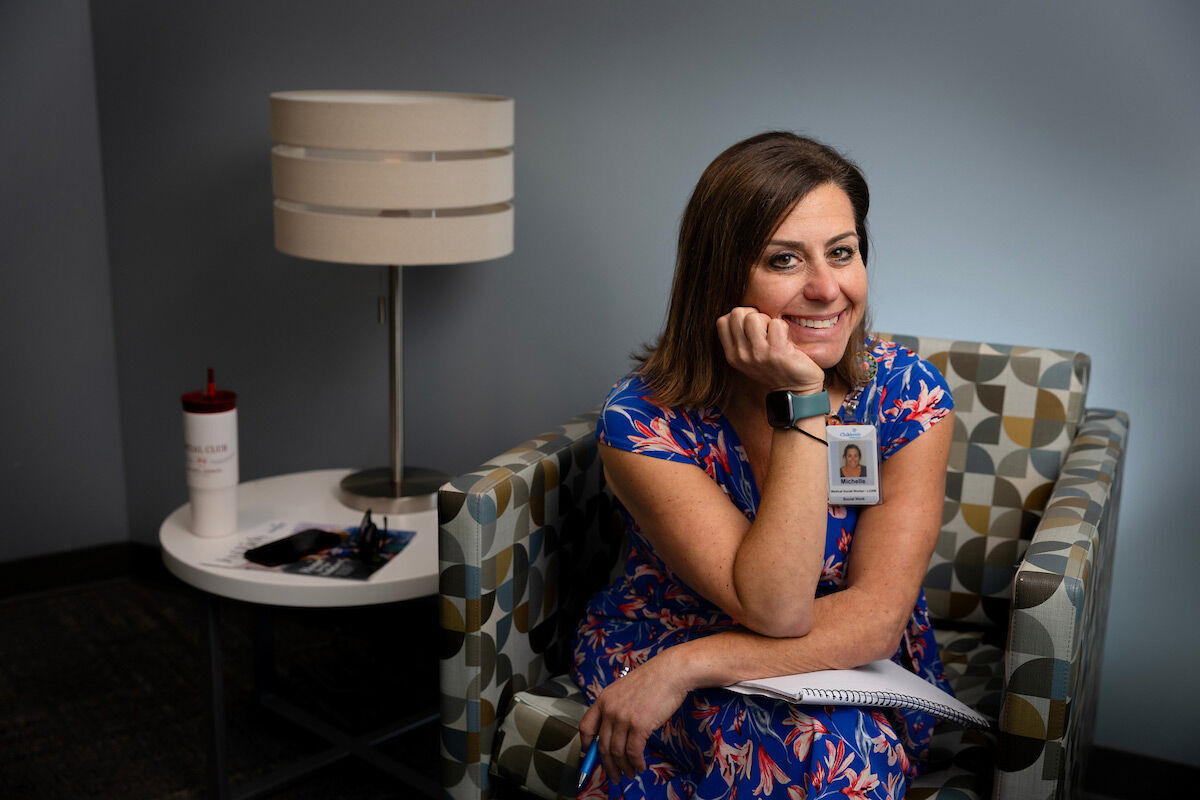
An alumna from the Grace Abbott School of Social Work at the University of Nebraska at Omaha (UNO), Patton is a social worker in the hospital’s emergency department, where 12-hour shifts can stretch longer, and she must be a positive force during the unimaginable.
Her work is like that seen on HBO’s The Pitt, where characters serving as social workers help patients and their loved ones during a particularly sensitive moment that health care professionals are not trained to address.
People are also reading…
These can be mental health assessments, trauma response, child abuse concerns, custody questions, and safety planning. And often her role is identifying resources for families struggling with food insecurity, eviction, or benefits that have stopped. It is urgent and emotional, but Patton is a standing example of the value of social workers in our communities.
“I really look at it as we are there, sometimes in families’ worst times and even sometimes in their best times,” she said. “Part of our role always is to help advocate.”
This was not her first career path, although she never doubted her choice and saw everything she had experienced helped her as a social worker. Pursuing a degree in criminal justice, she took an internship at a probation office in Chicago, which gave her early experience at entering homes, talking with families, and building trust quickly.
After graduation, she began working at Child Saving Institute, a nonprofit organization that addresses child abuse and neglect, as part of an intensive family preservation team that helped families navigating the court system due to some alleged form of abuse or neglect of their children. The job introduced her to social work, and colleagues encouraged her to consider UNO’s Master of Social Work program.
“I really liked the advocacy part and the support and the proactiveness,” she says. “It just seemed like a much better fit for me and what I wanted to do.”
Patton earned her Master of Social Work degree from UNO in 2004. Her criminal justice background still informs her approach, teaching her to build rapport quickly and remain nonjudgmental when people are angry or overwhelmed.
Those skills matter in the emergency department, where patients and families are already under a great deal of stress and may have already spent long hours or days in the hospital. And many are coming from outside the Omaha metro area as well.
After mental health assessments, when children can go home, Patton and her colleagues work closely with parents and health providers on safety plans, as well as making it clear that the child can always return to the emergency department if needed. That often means talking about locking up medications, behavior changes, and other risks.
The job sometimes requires a quieter presence. In trauma cases, Patton may sit with parents in holding spaces while medical teams work around their child. Sometimes she answers questions. Sometimes she helps parents, or maybe even one of the parents, to find the moment to step away and breathe. And sometimes she simply stays nearby.
“It’s OK to just sit there, be with them, not even say a word. It can be a comfort for them just to know someone’s there,” she says.
Patton says social workers are valued members of the interdisciplinary team at Children’s, working alongside physicians, nurses, psychiatrists, neurologists, and child specialists. The need has grown so much that emergency department social workers now provide 24-hour coverage.
And with this emphasis on the need for more social workers to help with more delicate cases, Patton has seen the field evolve with it over her more than two decades in the profession. She has seen the field become more trauma-informed along with a growing need for more social workers outside of the hospital and to focus on more than behavior. Now, she finds the need to ask broader questions about what families have experienced and connecting them to more specific resources that fit each family.
She points at how UNO has given her the foundation for this career, crediting her strong group of professors, meaningful practicum experiences, and a supportive cohort that has aided her. The degree, she says, became the base for everything that followed.
Her advice for new social workers is simple: protect your boundaries, stay open-minded, and give yourself grace. The work is hard, but the mission remains steady.
“Our job is still the same,” she says. “To help support and advocate for families.”