Mary Bushman, daughter of Melvin Meyer's wife, Vivian, speaks on what it means to the Meyer family to have their solider return home and buried after so many years. Meyer B. Meyer is a World War II veteran from Overland whose remains were identified from a plane crash site in Germany almost …
In an airmail letter to his parents from besieged Corregidor Island in the Philippines, Army Capt. Ronald O. Pigg predicted he would have “a bunch of stories to tell” when World War II ended and he finally could return home to Omaha.
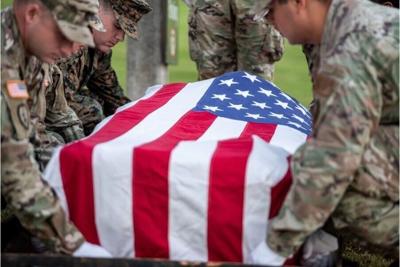
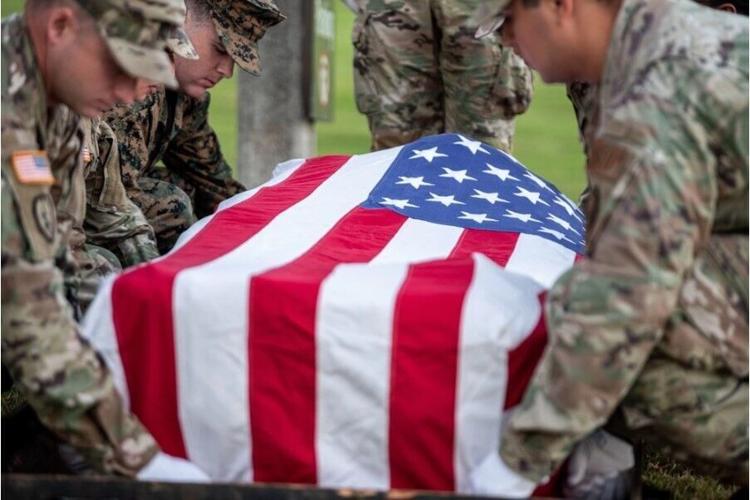
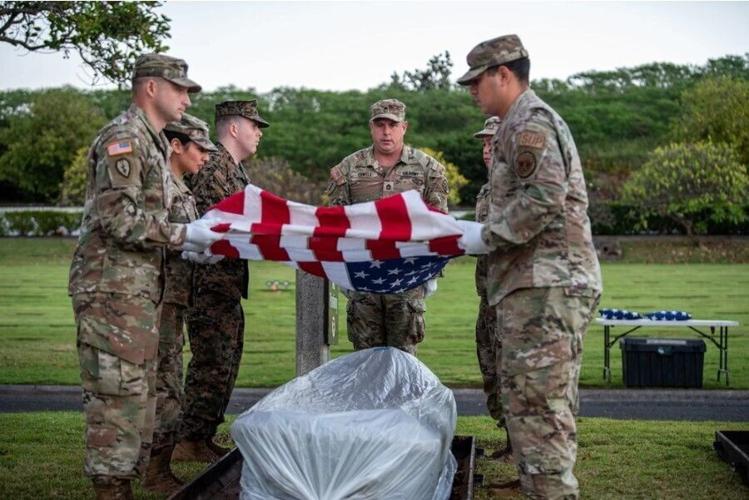
Members of a military honor guard at the National Memorial Cemetery of the Pacific in Honolulu unfold a flag over a casket holding remains associated with the loss of the Japanese POW transport “hell ship” Enoura Maru Jan. 9, 1945 at Takao, Taiwan.
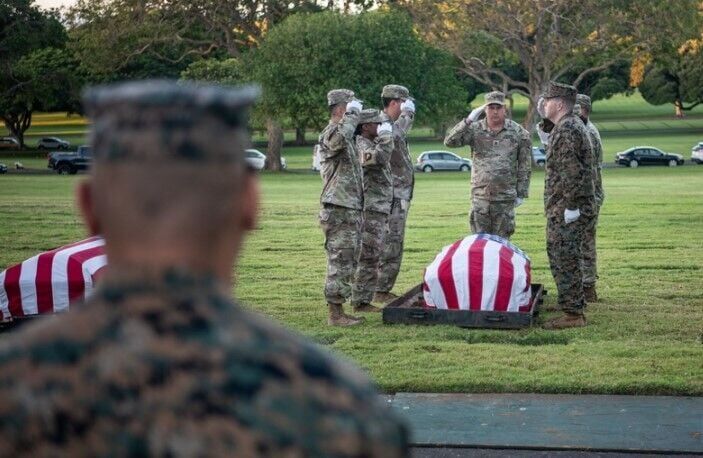
Members of a military honor guard at the National Memorial Cemetery of the Pacific in Honolulu salute a casket holding remains associated with the loss of the Japanese POW transport "hell ship" Enoura Maru.
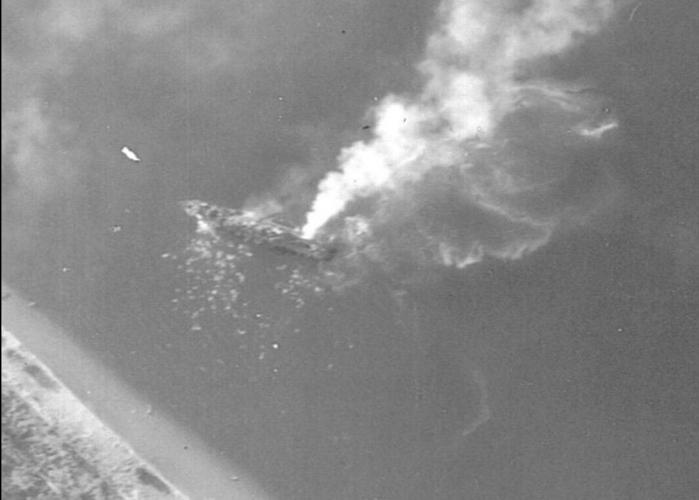
The Japanese “hell ship” Oryoku Maru burns in the Philippines after an unwitting friendly fire attack Dec. 15, 1944, by U.S. military aircraft from the carrier USS Hornet, killing about 270 of the 1,621 POWs on board, most of them American. The survivors were loaded aboard two other hell ships, and about 400 more POWs were killed when one of them, the Enoura Maru, was attacked by aircraft from Hornet at Takao, on the island of Formosa. Hundreds more died of their wounds, or of disease and starvation, during the 16-day journey from Formosa to Japan aboard a third ship, the Brazil Maru.
NATIONAL ARCHIVES, VIA DEFENSE POW/MIA ACCOUNTING AGENCY
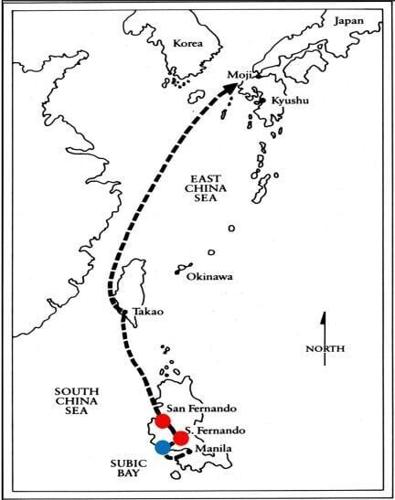
Of 1,621 U.S. and Allied POWs who were crammed by their Japanese captors aboard the hell ship Oryoku Maru on Dec. 13, 1944, fewer than 500 survived to reach their destination of Moji, Japan, six weeks later. They endured the sinking of two ships by U.S. attack aircraft as well as starvation, dehydration, disease, suffocation, even executions. Those who survived the ordeal were described as "walking skeletons."
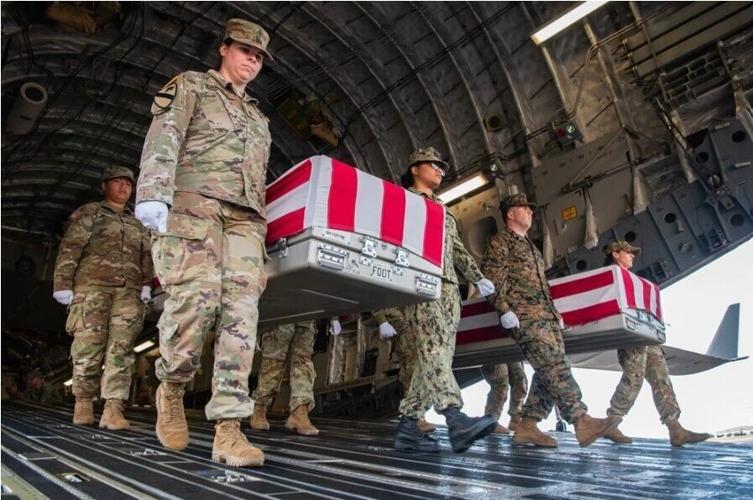
Pallbearers remove a flag-draped transfer case bearing the remains of unidentified service members from a cargo plane at Joint Base Pearl Harbor-Hickam, Hawaii, March 16. The remains have been buried at Manila American Cemetery in the Philippines since the 1940s and are thought to be American POWs associated with the Japanese transport “hell ship” Orokyu Maru, which was sunk by a U.S. aircraft Dec. 15, 1944.
Members of a military honor guard at the National Memorial Cemetery of the Pacific in Honolulu place a flag over a casket holding remains associated with the loss of the Japanese POW transport Enoura Maru Jan. 9, 2023, the 78th anniversary of the U.S. attack on the unmarked "hell ship." As many as 400 American POWs are believed to have died in the attack and are now being identified at the Defense POW/MIA Accounting Agency laboratory at Offutt Air Force Base.
Of 1,621 POWs loaded aboard the Oryoku Maru in Manila Dec. 13, 1945, fewer than 500 made it to Japan six weeks later following attacks on that ship in the Philippines and the Enoura Maru in Taiwan. Nearly 80 years later, 985 remain unaccounted for. At least 12 are from Nebraska:
Navy Lt. jg Edward W. Bayer, 41, of Bayard.
Army Lt. Col. William O. Boger, 55, of Omaha.
Army Maj. Earl C. Frandsen, 43, Norfolk.
Navy Pharmacists Mate 2nd Class Roland E. Going, 30, of Platte Center.
Pallbearers remove a flag-draped transfer case bearing the remains of unidentified service members from a cargo plane at Joint Base Pearl Harbor-Hickam, Hawaii, March 16. The remains have been buried at Manila American Cemetery in the Philippines since the 1940s and are thought to be American POWs associated with the Japanese transport “hell ship” Orokyu Maru, which was sunk by a U.S. aircraft Dec. 15, 1944.
Members of a military honor guard at the National Memorial Cemetery of the Pacific in Honolulu place a flag over a casket holding remains associated with the loss of the Japanese POW transport Enoura Maru Jan. 9, 2023, the 78th anniversary of the U.S. attack on the unmarked "hell ship." As many as 400 American POWs are believed to have died in the attack and are now being identified at the Defense POW/MIA Accounting Agency laboratory at Offutt Air Force Base.
Members of a military honor guard at the National Memorial Cemetery of the Pacific in Honolulu unfold a flag over a casket holding remains associated with the loss of the Japanese POW transport “hell ship” Enoura Maru Jan. 9, 1945 at Takao, Taiwan.
Members of a military honor guard at the National Memorial Cemetery of the Pacific in Honolulu salute a casket holding remains associated with the loss of the Japanese POW transport "hell ship" Enoura Maru.
The Japanese “hell ship” Oryoku Maru burns in the Philippines after an unwitting friendly fire attack Dec. 15, 1944, by U.S. military aircraft from the carrier USS Hornet, killing about 270 of the 1,621 POWs on board, most of them American. The survivors were loaded aboard two other hell ships, and about 400 more POWs were killed when one of them, the Enoura Maru, was attacked by aircraft from Hornet at Takao, on the island of Formosa. Hundreds more died of their wounds, or of disease and starvation, during the 16-day journey from Formosa to Japan aboard a third ship, the Brazil Maru.
NATIONAL ARCHIVES, VIA DEFENSE POW/MIA ACCOUNTING AGENCY
Of 1,621 U.S. and Allied POWs who were crammed by their Japanese captors aboard the hell ship Oryoku Maru on Dec. 13, 1944, fewer than 500 survived to reach their destination of Moji, Japan, six weeks later. They endured the sinking of two ships by U.S. attack aircraft as well as starvation, dehydration, disease, suffocation, even executions. Those who survived the ordeal were described as "walking skeletons."