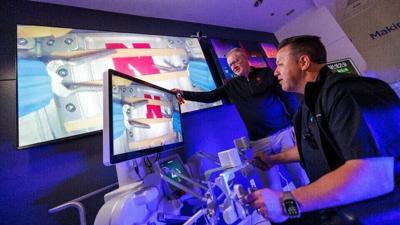
It's been a big past 12 months for Virtual Incision.

University of Nebraska engineering professor Shane Farritor (center, top) watches as Dr. Michael Jobst, a colorectal surgeon in Lincoln, makes the first surgical robotic cut on the International Space Station. Using controls at the offices of Virtual Incision in Lincoln, Jobst and five other surgeons cut rubber bands — mimicking surgery inside a payload box on the space station.
People are also reading…
Made right here: 12 things you may not know came from Nebraska
1 - Kool-Aid

In the 1920s, Hastings native Edwin Perkins was inspired by a juice-flavored drink concentrate called Fruit Smack. In his mother’s kitchen, he played around with formulas to remove the liquid from the drink until only a powder remained — a process that would reduce shipping costs. The result was what became known as Kool-Aid. Perkins moved production to Chicago in 1931, and Kool-Aid was sold to General Foods in 1953. Hastings still celebrates an annual summer festival called Kool-Aid Days on the second weekend in August. The beverage is known as Nebraska’s official soft drink.
Car rentals

Appropriately located in a former horse stable, the Ford Livery Company at 1314 Howard Street was America's first car rental company, dreamed up in 1916 by Joe Saunders. He and his brothers expanded their company, later renamed Saunders Drive It Yourself System, to 56 cities by 1926. They sold to Avis in 1955.
4 - Reuben

The tasty concoction of corned beef, Swiss cheese, sauerkraut and Russian dressing was invented at Omaha’s Blackstone Hotel by Reuben Kulakofsky. It first appeared on a Blackstone menu in 1925 and is now served internationally.
6 - Vise-Grip

These days, the pliers are made in China, but the handy tool was made at a plant in Dewitt, Nebraska, until 2008. William Petersen, a blacksmith in DeWitt, came up with the idea for locking pliers in the early 1920s. He patented his first wrench in 1921, but the first Vise-Grip wrench with a locking handle was not patented until 1924. Petersen originally sold the pliers from the trunk of his car, but later formed a company and began manufacturing Vise-Grips in DeWitt in 1938. The company was acquired by Irwin Tools in 1993.
7 - Chair lift

Union Pacific engineer (not the train kind) James Curran came up with the design for the ski chairlift in 1936. He was inspired by hook-equipped banana conveyor systems that loaded cargo ships in the tropics. The first chairlifts were installed at a ski resort in Sun Valley, Idaho, in 1936 and 1937.
8 - Cliffsnotes

In 1958, Cliff Hillegass was working at Nebraska Book Co. when he met a Canadian man who published study guides. Hillegass acquired the American rights to the product and produced them under the name CliffsNotes. He continued to develop more, working from Lincoln. The company would go on to produce reference guides for subjects other than literature, saving the academic lives of millions of students time and again.
9 - Richtig

When blacksmith-turned-knifemaker Frank J. Richtig made a name for himself among knife enthusiasts by dramatically demonstrating his knives. Using a hammer, he would pound the blade completely through a ¾-inch-thick steel strap. Then he would slice a piece of paper with the knife that had cut through steel. Richtig’s feat was possible because the steel had been hardened through a process he both discovered and took to his grave in 1977. Richtig’s knives — many of which are in private collections — have been valued at more than $4,000 each.
Eskimo Pie

Inspiration for the chocolate-coated ice cream bar came from a candy store in Onawa, Iowa, in 1920. But it wasn’t until owner and creator Christian Kent Nelson took his invention to a Nebraska chocolatier named Russell Stover that the Eskimo Pie went into mass production. Many variations of the delicious treat are available in grocery and convenience stores worldwide.
11 - SAFER barrier

The Steel and Foam Energy Reduction (SAFER) Barrier was developed at the Midwest Roadside Safety Facility at the University of Nebraska-Lincoln between 1998 and 2002. Dean Sicking led a team of engineers to create the special safety wall for racetracks, which reduces the danger to drivers in a crash. The system was installed on many IndyCar and NASCAR circuit tracks.
12 - TV dinners

In the 1950s, Swanson met the needs of busy American families with the creation of a meal that was easy and fast to prepare in single portions. Several other frozen dinners had been developed by other companies, but Omaha-based Swanson developed the idea on a nationwide scale. Though it’s widely assumed that the term “TV dinner” came from families eating the frozen meals in front of the television at dinner time, food historians say the name came from the tray’s original shape, which resembled a 1950s TV.