

50 space terms for understanding the universe
In honor of National Space Day on May 6, Stacker has compiled a list of key astronomy and astrophysics terms that are out of this world!
50 space terms for understanding the universe
Oct. 1, 2020, marks the 62nd birthday of the National Aeronautics and Space Agency, or NASA. The agency was founded in 1958, the same year President Dwight D. Eisenhower signed the National Aeronautics and Space Act and one year after the Soviets launched Sputnik 1, the world’s first artificial satellite. NASA was designed from the start to push the bounds of space exploration with research into aerospace and aeronautics as well as with a civilian space program.
From putting footprints on the moon in 1969, to launching satellites into space in 1972 to take images of the Earth’s surface, to a proposed 2020 mission to gather samples from Mars, NASA continues to expand our understanding of the vastness of space and change the way we perceive our solar system (and all that lays beyond it). NASA has gathered unimaginable footage, created first-hand accounts of space, and fostered cutting-edge research. Through the creation of new technologies and procedures, NASA created a foundation of ideas that were previously only theories.
As the agency unrelentingly forged a path toward astronomical discovery, NASA also invented a number of technologies that we use in our everyday lives. These include artificial limbs, LASIK surgery, improved water filtration, camera phones, freeze-dried foods, memory foam, LED lights, and even the Dust Buster. In fact, it was a NASA scientist who invented the Super Soaker squirt gun. In honor of NASA’s birthday, Stacker has compiled a list of key astronomy and astrophysics terms from a variety of authoritative science communication sources, including Crash Course: Astronomy, How Stuff Works, and International Comet Quarterly. Keep reading to learn the terms that are commonly used in this fascinating field.
You may also like: Can you answer these real 'Jeopardy!' questions about space?
#1. Aberration of light

Similar to how raindrops hit a moving car window as if from an angle, an aberration of light is the phenomenon where stars or other celestial bodies appear from Earth to be slightly off from their true position. This happens because of motion—specifically, the interaction of the Earth’s movement with the speed of light causes this confusing phenomenon.
[Pictured: The bright vertical line and the other rays with barred lines are aberrations caused by the bright flash of the solar flare in a sunspot, 2017.]
#2. Alpha Centauri
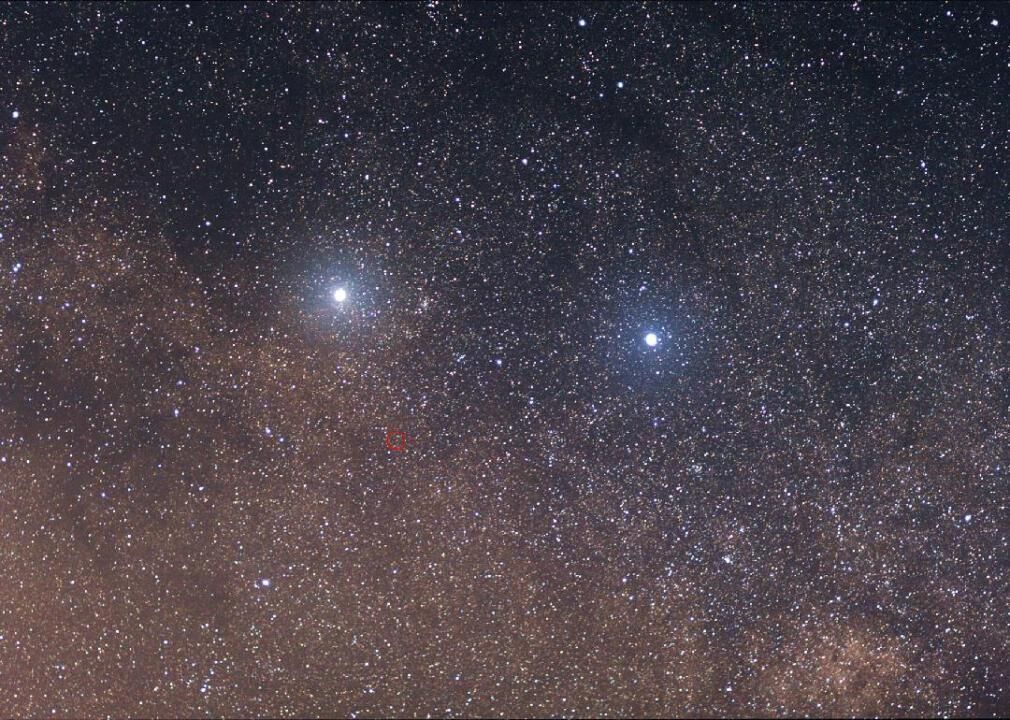
Alpha Centauri is the name of the closest star system to earth. It comprises two main stars, Alpha Centauri A and Alpha Centauri B, as well as the closest of the three stars, Proxima Centauri. In 2016, astronomers found an Earth-sized planet orbiting Proxima Centauri, later named Proxima b. While this planet shows signs that life could exist, astronomers are still unsure how habitable it is.
[Pictured: Alpha Centauri (left) and Beta Centauri (right).]
#3. Andromeda Galaxy

Also known as M31, this galaxy is the closest to the Milky Way, where the Earth exists. Andromeda Galaxy has a similar structure to the Milky Way; it is spiral in shape and has a large density of stars, dust, and gas. Because of its proximity, it is the only galaxy that can be seen from Earth with the unaided eye, particularly on fall and winter nights.
#4. Asteroid
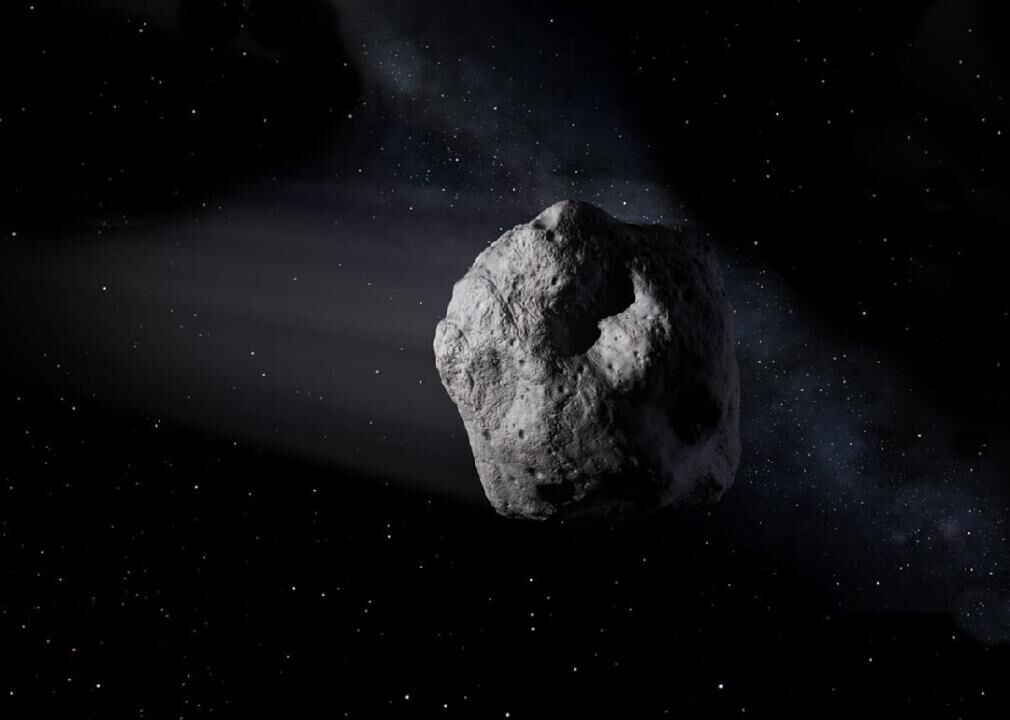
Asteroids are chunks of rock or metal that used to be parts of other small planets that have broken off due to a collision in space and now orbit the sun. The name asteroid means “star-like.” referring to their emission of light. Asteroids can be lumped into orbital groupings called families and form into an asteroid belt.
#5. Barycenter

A barycenter is the common center mass around which a solar system orbits. While it has become common knowledge that planets orbit stars, it is, in fact, the barycenter that both stars and planets orbit around. Our solar system’s barycenter is constantly changing position based on where each of the planets is in its orbit, ranging from being near the center of the sun to being just outside its surface.
#6. Big Bang

The Big Bang Theory is a model describing the origin of the universe. It explains how the universe expanded from a high-density, high-temperature state into the cosmos we see today. Although there are alternative theories, this is the most widely recognized theory of how the universe began.
[Pictured: Hubble Space Telescope observed one of the most massive known galaxy clusters, RX J1347.5–1145.]
#7. Binary star

Binary stars are systems that only contain two stars that orbit together. Together, they orbit a common center of mass. There are two types of binary stars: wide binaries and close binaries. Wide binaries orbit with a significant distance apart from each other, causing them to have little effect on each other. Close binaries orbit closely and actually can acquire material from one another.
[Pictured: An artist's depiction of the binary star series, J0806.]
#8. Black hole

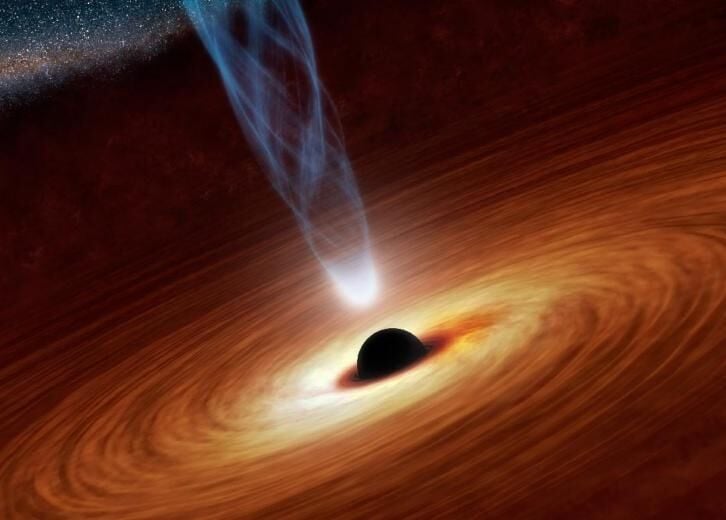
Made famous by Einstein’s theory of general relativity, a black hole is the small dense core remnant of a dead star. Since the density of this core is more than about three times more than the density of the sun, the strong force of gravity produces a black hole.
[Pictured: Artist's concept of a supermassive black hole.]
#9. Brown dwarf

A brown dwarf is born from a collapse of gas and dust, similar to stars. This collapse creates a large amount of energy that gets trapped in a ball of material. The energy emits light from within for tens of millions of years, becoming dimmer as time passes.
[Pictured: Artist's concept of a brown dwarf with bands of clouds.]
#10. Celestial sphere

A celestial sphere is a tool used in spherical astronomy. It is a sphere with a large radius that is concentric with Earth. The sky surrounding the Earth is projected on the sphere, which is helpful for astronomers when they are attempting to plot positions in situations where distances aren’t important.
#11. Comet

Besides being a beautiful phenomenon that’s rarely visible from Earth, comets are icy, frozen balls of gas, rock, and dust. Comets gain their trademark bright glow by emitting gas as their orbit passes close to the sun, sometimes even resulting in a glowing tail.
[Pictured: The Kitt Peak National Observatory in Arizona captured this image of Comet NEAT, 2004.]
#12. Constellation

One of the first things we learn about space is its many constellations. From Orion and his belt to the mythical Seven Sisters and the big and little dipper, constellations map out a group of stars that form shapes in the sky. Constellations were first used by explorers to map direction as well as a tool for storytelling.
[Pictured: A picture of the Big Dipper taken at Koke'e State Park in Hawaii.]
#13. Dark energy

Like the cosmic mystery its name evokes, dark energy is hard to define. The easiest way to think of it is a property of space that accounts for an expanding universe. The universe’s “empty space” may still have its own, dark energy. However, scientists are still trying to pin down the properties of this dark energy that makes up most of the universe.
[Pictured: Artist's conception of dark energy represented by the purple grid, and gravity by the green grid below.]
#14. Dark matter

Somewhat similar to dark energy, dark matter also covers a large chunk of the universe and remains quite mysterious to scientists. The main difference is that dark matter explains more of how groups of objects in the universe function together. Though scientists have a greater understanding of what dark matter isn’t than what it is, a leading theory posits dark matter is made from exotic particles like axions or Weakly Interacting Massive Particles (WIMPS).
[Pictured: Composite image shows the distribution of dark matter, galaxies, and hot gas in the core of the merging galaxy cluster Abell 520.]
#15. Doppler shift

Also known to most as the Doppler effect, the Doppler shift explains the phenomenon of the change in frequency of a wave in relation to an observer. This can be observed when an ambulance drives past you and the volume of the siren doesn’t quite match with the proximity of the ambulance to you.
[Pictured: Doppler shift due to stellar wobble caused by an exoplanet.]
#16. Eclipse

An eclipse refers to one body in space moving into the shadow of another body. Eclipses can exist in two forms—solar and lunar—depending on the orbit of the Earth and moon. With a lunar eclipse, the moon moves behind the Earth. During a solar eclipse, the moon orbits between the Earth and the sun.
[Pictured: Moon traversing the face of the sun during a solar eclipse.]
#17. Equinox

During an equinox, Earth experiences an even 12 hours of daytime and 12 hours of nighttime. This occurs twice a year: The March equinox marks spring’s arrival in the Northern Hemisphere and Fall in the Southern Hemisphere. The September equinox ushers in the fall’s arrival in the north and spring in the south.
[Pictured: Cassini captures equinox on Saturn.]
#18. Escape velocity

Escape velocity is the speed that an object needs in order to escape a planet or moon’s gravitational pull. For example, the escape velocity for a spaceship to leave the surface of Earth is about 25,000 miles per hour.
[Pictured: Luna 1 was the first man-made object to attain escape velocity from Earth.]
#19. Exoplanet

When planets exist beyond our solar system and orbit a star other than the sun, they are called an exoplanet. Exoplanets are extremely hard to see, as they are often hidden by the glare of the star they orbit. Because of that, the first exoplanet was not recognized until 1992.
[Pictured: Kepler's exoplanet discovery.]
#20. Fermi paradox

Named after Italian-American physicist Enrico Fermi, the Fermi paradox is a theory using statistical analysis to postulate why we have yet to see signs of life on other planets within our galaxy. The paradox assesses the likeliness that there are similar planets to Earth within the Milky Way, and likely have the ability to support life, yet no signs of life have been found which means it’s a paradox.
[Pictured: Enrico Fermi, Italian-American physicist, received the 1938 Nobel Prize in physics.]
#21. Galaxy

We all know that we live in the Milky Way galaxy, but what exactly is a galaxy? A galaxy is a wide-ranging mix of dust, gas, stars, and various solar systems brought together by a singular gravitational pull.
[Pictured: The perfectly picturesque spiral galaxy known as Messier 81, or M81, looks sharp in this new composite from NASA's Spitzer and Hubble space telescopes and NASA's Galaxy Evolution Explorer.]
#22. Gamma-ray burst

A gamma-ray burst is the most violent type of explosion in the universe. The explosion itself emits more energy in 10 seconds than the sun will emit in its lifetime. When it happens, it’s the brightest source of light in the observable universe. Satellite evidence suggests gamma-ray bursts are the result of matter collapsing into black holes.
[Pictured: Illustration of a gamma-ray burst.]
#23. Gravity

Based on the Latin word for “weight,” gravity is a natural phenomenon where things with mass or energy are drawn toward its center. The force of gravity is what keeps us planted on Earth’s surface and also keeps the Earth orbiting the sun.
[Pictured: Stephen Hawking (center) enjoys zero gravity during a flight aboard a modified Boeing 727 aircraft.]
#24. Hypergalaxy

A hypergalaxy consists of one large dominant galaxy surrounded by various smaller tertiary galaxies. The Milky Way and our neighboring Andromeda galaxies are both hypergalaxies.
[Pictured: The Milky Way, an example of a hypergalaxy.]
#25. Light-year
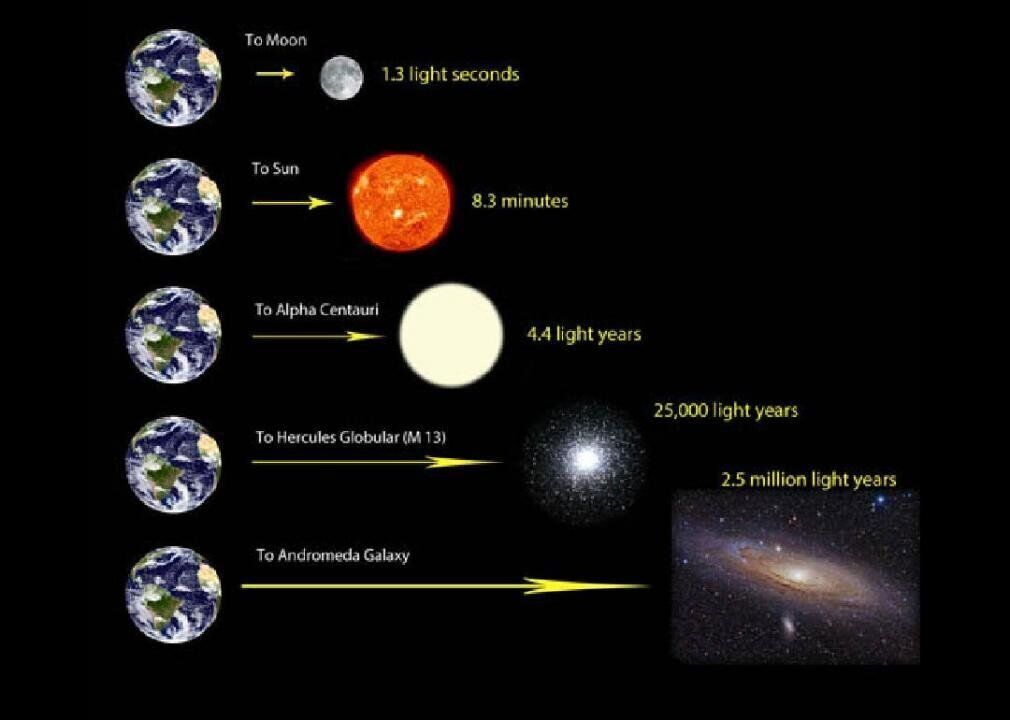
A light-year is as simple a concept as its name suggests. It is an astronomical distance that measures the distance that light travels in a year. One light-year roughly equates to 6 trillion miles.
#26. Magellanic clouds

Understanding Magellanic clouds has become a propelling source of understanding distant galaxies. They consist of two irregular galaxies that orbit the Milky Way. Orbiting about 200,000 light-years away, the Magellanic clouds are formed by the Large Magellanic Cloud and the Small Magellanic Cloud.
[Pictured: Small Magellanic Cloud galaxy captured by NASA's Great Observatories.]
#27. Magnitude

Magnitude refers to a mathematical measurement for something's size or extent in comparison to other similar objects. In astronomy, magnitude is a unitless system used to measure the varying degrees of brightness of objects in the sky. Greek astronomer Hipparchus introduced the concept of magnitude for classifying stars in 129 B.C., referring to the brightest stars in the sky as "first magnitude."
[Pictured: This is a low-resolution version of the skymap. The threshold magnitude is 3.0 so the Milky Way is very faint.]
#28. Meteor

A meteor is a rocky object or asteroid that vaporizes when entering the Earth’s atmosphere. They’re often called “shooting stars” and provide a beautiful glowing tail as they enter the atmosphere. Next time you see one, be sure to make a wish upon a meteor!
[Pictured: A meteor during the Leonid meteor shower.]
#29. Milky Way

The Earth’s galactic home, the Milky Way is a spiral galaxy that is constantly rotating. The Milky Way contains a high amount of dust and gas wrapped around the central galactic bulge. The galactic bulge contains a dense amount of dust, gas and stars. And within that bulge, exists a large black hole (see slide #8). Our solar system lies about 30,000 light-years from the galaxy’s center.
[Pictured: The Milky Way captured by NASA's Spitzer Space Telescope.]
#30. Moon

The moon is a heavenly body that orbits the Earth and happens to be the easiest object to spot in the night sky. As the moon orbits our planet, we see it go through “phases,” where at different times different proportions of the moon’s surface are visible. These phases have guided time since the beginning of humanity. The calendar month roughly replicates the moon’s orbit of the Earth.
[Pictured: Moon's north pole assembled from 18 images captured by Galileo's imaging system.]
#31. Nebula

A nebula is a large cloud of dust and gas in space that is produced when a star dies. The gas and dust eventually clump together into a mass large enough to form its own gravity. Nebulae can also be places for new stars to form and are sometimes referred to as “star nurseries.”
[Pictured: The Seagull nebula.]
#32. Nebular hypothesis

The Nebular hypothesis is the most widely accepted theory of how our solar system was born. The theory itself was born during the Scientific Revolution from the 16th to18th centuries. The theory’s essence states that our solar system was birthed from a nebula billions of years ago. The theory has also been applied to how all stars came to be.
[Pictured: The nebular hypothesis of Laplace, 1882.]
#33. Neutron star

Neutron stars are small, but very dense objects that are birthed by the explosive death of a giant star. Neutron stars can exist in two states. The first is a pulsar, which emits a narrow radiation beam. The second is a magnetar, which has a powerful magnetic field that has the force to distort atoms.
[Pictured: Artist's illustration of an 'isolated neutron star.']
#34. Oort Cloud

Named after astronomer Jan Oort whose theory about a cloud comprising a shell of icy objects existing beyond the Kuiper Belt, or the region that exists in our solar system beyond Neptune, could be responsible for the long-term comets visible from Earth (like Halley’s). The cloud is theorized to comprise the remains of disc materials of planets and the sun.
[Pictured: This artist's concept puts solar system distances in perspective.]
#35. Orbit

In short, an orbit is the gravitationally curved trajectory of an object in space. In other words, an orbit is the circular motion in which objects in space travel due to gravity’s pull. For example, the moon orbits around the Earth and the Earth orbits around the sun in a circular motion. An object that orbits another is called its satellite.
[Pictured: The International Space Station orbits above Earth.]
#36. Parallax

Measuring using parallax involves estimating the distance of nearby celestial objects by measuring movement against more distant celestial objects. This method is often used when measuring distances of neighboring stars, called stellar parallax.
[Pictured: Artist's concept of parallax.]
#37. Quasar

Quasars are large distant objects in space that are powered by large, powerful black holes. They tend to shine so brightly that their light eclipses the old galaxies that they exist within. They are capable of emitting thousands of times more energy than the Milky Way emits.
[Pictured: Artist's concept of a quasar.]
#38. Red giant

A red giant is a star that is reaching its final days and approaching death. If a star has turned into a red giant, the star is in the last states of its stellar evolution and expands. Our own sun will eventually expand and turn into a red giant—but not for a few billion years.
[Pictured: Image shows the "bow shock" of a dying star named R Hydrae, or R Hya, in the constellation Hydra.]
#39. Red shift

Red shift and blue shift explain how light changes wavelength as objects in space move closer or farther from each other. As an object moves away from us, the light is shifted towards the red end of the color spectrum. In turn, as it moves closer, the light shifts towards the blue end of the spectrum. Along with blue shift, red shift is hugely valuable in understanding the universe’s expansion.
[Pictured: Image of what could be the most distant galaxy ever seen. The small galaxy's starlight has been stretched into longer wavelengths, or "redshifted," by the expansion of the universe.]
#40. Solar system

A solar system is a gravitationally bound system of a sun and the objects that orbit it. That includes the bodies that orbit the objects orbiting the sun. For example, our solar system contains the sun, the planets that orbit it, as well as moons and other objects that orbit them.
[Pictured: Stylized rendition of our solar system.]
#41. Solar wind
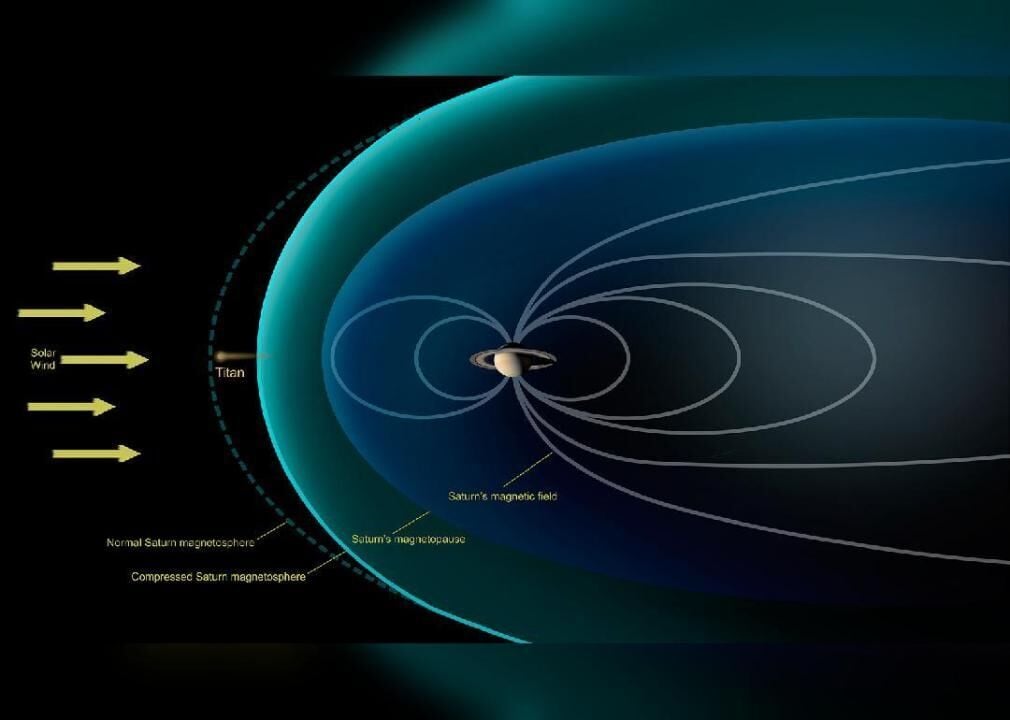
Solar wind is a wind streaming solar particles and plasma from the sun. As a solar wind carries charged particles from the sun towards the Earth could have catastrophic effects for Earth’s habitants. But don’t worry, Earth’s magnetic field provides a pretty sturdy shield against any of these negative effects.
[Pictured: Conditions observed by NASA's Cassini spacecraft during a flyby depicting solar wind on Titan.]
#42. Spaghettification

Sometimes referred to as the “noodle effect,” Spaghettification is when the extreme tidal forces stretch out objects to be long and thin like a noodle. This effect can also be caused by the immense gravitational pull of a black hole.
[Pictured: Illustration showing what spaghettification will do to an astronaut entering a small black hole's event horizon.]
#43. Star

Other than serving as beautiful guiding lights in our sky, stars are astronomical objects that are composed of gas that pulls itself together with its own gravitational pull. Nuclear fusion at the star’s core creates the light that stars emit.
[Pictured: Star from the Lizard constellation.]
#44. Star cluster

In the same way that planets can be gravitationally bound to the sun, causing them to orbit it, stars can also cluster together due to gravity. Two types of star clusters can be determined: globular clusters and open clusters. Globular clusters are tight clusters of thousands of older stars, whereas open clusters are made up of a few hundred very young stars.
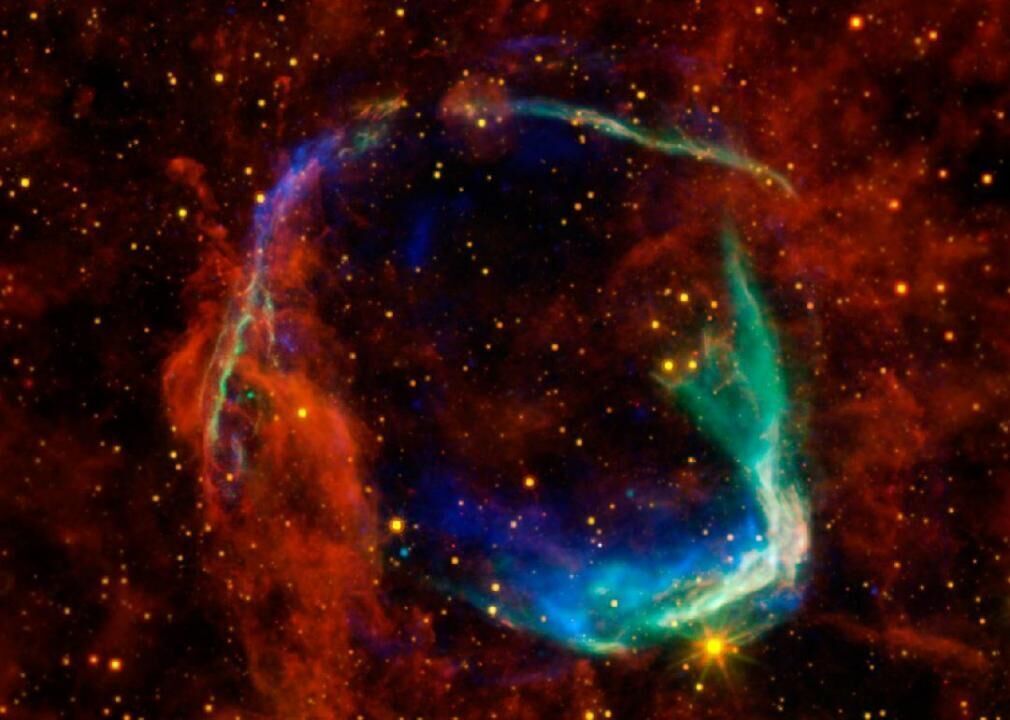
#45. Supernova

A supernova is the largest explosion that can be seen with the human eye. A supernova occurs as the last step of a dying massive star that emits an extremely bright light. This occurs in the death of a star at least five times the mass of our solar system’s sun.
[Pictured: Data combined from four different space telescopes to create a multi-wavelength view of a supernova called RCW 86.]
#46. Telescope

A telescope is the signature tool of astronomers to see far objects out in space in further detail. Today, telescopes are designed with curved mirrors that gather light from the sky and concentrates it so that far away objects are visible.
[Pictured: The Hubble Space Telescope as seen from the departing Space Shuttle Atlantis.]
#47. Theory of relativity

The theory of relativity was developed by Albert Einstein in 1905 and includes both theories of special relativity and general relativity. The theory determines that the laws of physics are the same for all non-accelerating observers and was monumental in introducing a framework for space and time.
#48. Tides

Tides are the rise and fall of sea level that is caused by the gravitational pull of the moon and the sun. They are one of the most reliable phenomena in the world. The difference between high and low tide is called the tidal range.
#49. White dwarf

A white dwarf is a relatively small star that is about the size of a planet that is very dense. It is essentially a star that has exhausted all of its nuclear fuel from within. It expels most of its outer material, leaving a white-hot core that cools over the next billion years.
[Pictured: NGC 7293, better known as the Helix nebula. The core of the star is a small, hot, dense remnant known as a white dwarf.]
#50. Universe

And lastly, we have landed at the universe. A loaded definition that has flummoxed scientists for generations, a universe contains billions of galaxies and even more stars along with their planets, moons, asteroids, comets, dust, and gas, all of which exists swirling around in the massive thing we call space.
[Pictured: Deep space images ever captured by the Hubble.]
You may also like: Can you answer these real 'Jeopardy!' questions about space?
50 space terms for understanding the universe

The National Aeronautics and Space Agency, or NASA, was founded in 1958—the same year President Dwight D. Eisenhower signed the National Aeronautics and Space Act and one year after the Soviets launched Sputnik 1, the world’s first artificial satellite. NASA was designed from the start to push the bounds of space exploration with research into aerospace and aeronautics as well as with a civilian space program.
In honor of National Space Day on May 6, Stacker compiled a list of key astronomy and astrophysics terms from a variety of authoritative science communication sources, including Crash Course: Astronomy, How Stuff Works, and International Comet Quarterly.
As the agency unrelentingly forged a path toward astronomical discovery, NASA also invented a number of technologies that we use in our everyday lives. These include artificial limbs, LASIK surgery, improved water filtration, camera phones, freeze-dried foods, memory foam, LED lights, and even the Dust Buster. In fact, it was a NASA scientist who invented the Super Soaker squirt gun.
Keep reading to learn the terms that are commonly used in this fascinating field.
You may also like: Can you answer these real 'Jeopardy!' questions about space?

#1. Aberration of light

Similar to how raindrops hit a moving car window as if from an angle, an aberration of light is the phenomenon where stars or other celestial bodies appear from Earth to be slightly off from their true position. This happens because of motion—specifically, the interaction of the Earth’s movement with the speed of light causes this confusing phenomenon.
[Pictured: The bright vertical line and the other rays with barred lines are aberrations caused by the bright flash of the solar flare in a sunspot, 2017.]
#2. Alpha Centauri

Alpha Centauri is the name of the closest star system to earth. It comprises two main stars, Alpha Centauri A and Alpha Centauri B, as well as the closest of the three stars, Proxima Centauri. In 2016, astronomers found an Earth-sized planet orbiting Proxima Centauri, later named Proxima b. While this planet shows signs that life could exist, astronomers are still unsure how habitable it is.
[Pictured: Alpha Centauri (left) and Beta Centauri (right).]
#3. Andromeda Galaxy
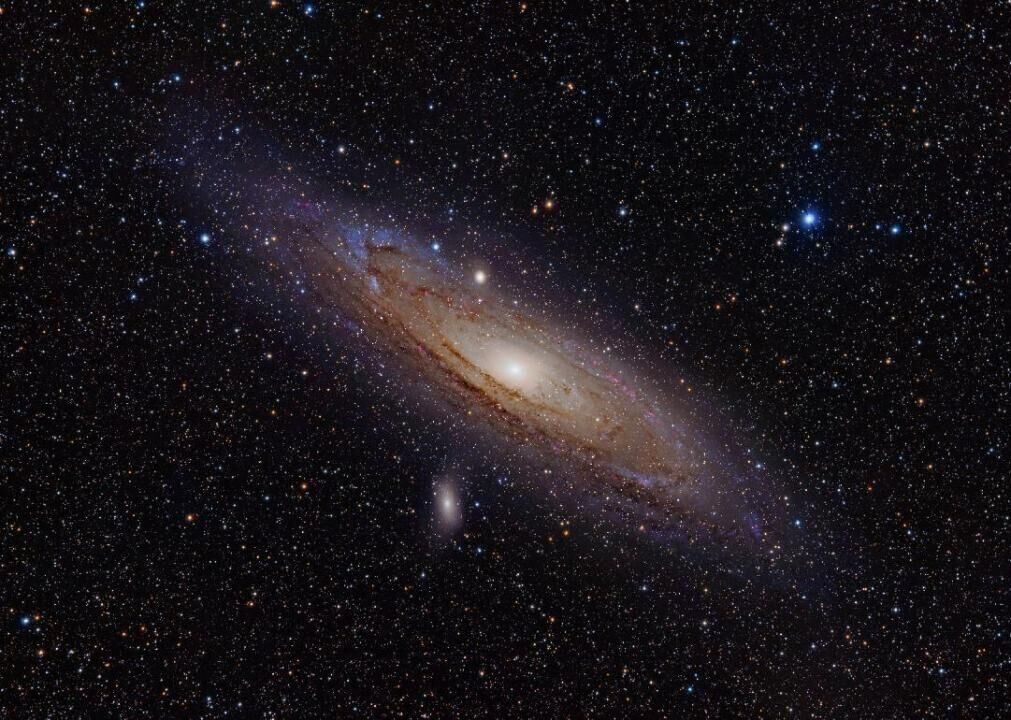
Also known as M31, this galaxy is the closest to the Milky Way, where the Earth exists. Andromeda Galaxy has a similar structure to the Milky Way; it is spiral in shape and has a large density of stars, dust, and gas. Because of its proximity, it is the only galaxy that can be seen from Earth with the unaided eye, particularly on fall and winter nights.
#4. Asteroid

Asteroids are chunks of rock or metal that used to be parts of other small planets that have broken off due to a collision in space and now orbit the sun. The name asteroid means “star-like.” referring to their emission of light. Asteroids can be lumped into orbital groupings called families and form into an asteroid belt.
#5. Barycenter

A barycenter is the common center mass around which a solar system orbits. While it has become common knowledge that planets orbit stars, it is, in fact, the barycenter that both stars and planets orbit around. Our solar system’s barycenter is constantly changing position based on where each of the planets is in its orbit, ranging from being near the center of the sun to being just outside its surface.
#6. Big Bang

The Big Bang Theory is a model describing the origin of the universe. It explains how the universe expanded from a high-density, high-temperature state into the cosmos we see today. Although there are alternative theories, this is the most widely recognized theory of how the universe began.
[Pictured: Hubble Space Telescope observed one of the most massive known galaxy clusters, RX J1347.5–1145.]
#7. Binary star

Binary stars are systems that only contain two stars that orbit together. Together, they orbit a common center of mass. There are two types of binary stars: wide binaries and close binaries. Wide binaries orbit with a significant distance apart from each other, causing them to have little effect on each other. Close binaries orbit closely and actually can acquire material from one another.
[Pictured: An artist's depiction of the binary star series, J0806.]
#8. Black hole

Made famous by Einstein’s theory of general relativity, a black hole is the small dense core remnant of a dead star. Since the density of this core is more than about three times more than the density of the sun, the strong force of gravity produces a black hole.
[Pictured: Artist's concept of a supermassive black hole.]
#9. Brown dwarf

A brown dwarf is born from a collapse of gas and dust, similar to stars. This collapse creates a large amount of energy that gets trapped in a ball of material. The energy emits light from within for tens of millions of years, becoming dimmer as time passes.
[Pictured: Artist's concept of a brown dwarf with bands of clouds.]
#10. Celestial sphere

A celestial sphere is a tool used in spherical astronomy. It is a sphere with a large radius that is concentric with Earth. The sky surrounding the Earth is projected on the sphere, which is helpful for astronomers when they are attempting to plot positions in situations where distances aren’t important.
#11. Comet

Besides being a beautiful phenomenon that’s rarely visible from Earth, comets are icy, frozen balls of gas, rock, and dust. Comets gain their trademark bright glow by emitting gas as their orbit passes close to the sun, sometimes even resulting in a glowing tail.
[Pictured: The Kitt Peak National Observatory in Arizona captured this image of Comet NEAT, 2004.]
#12. Constellation

One of the first things we learn about space is its many constellations. From Orion and his belt to the mythical Seven Sisters and the big and little dipper, constellations map out a group of stars that form shapes in the sky. Constellations were first used by explorers to map direction as well as a tool for storytelling.
[Pictured: A picture of the Big Dipper taken at Koke'e State Park in Hawaii.]
#13. Dark energy

Like the cosmic mystery its name evokes, dark energy is hard to define. The easiest way to think of it is a property of space that accounts for an expanding universe. The universe’s “empty space” may still have its own, dark energy. However, scientists are still trying to pin down the properties of this dark energy that makes up most of the universe.
[Pictured: Artist's conception of dark energy represented by the purple grid, and gravity by the green grid below.]
#14. Dark matter

Somewhat similar to dark energy, dark matter also covers a large chunk of the universe and remains quite mysterious to scientists. The main difference is that dark matter explains more of how groups of objects in the universe function together. Though scientists have a greater understanding of what dark matter isn’t than what it is, a leading theory posits dark matter is made from exotic particles like axions or Weakly Interacting Massive Particles (WIMPS).
[Pictured: Composite image shows the distribution of dark matter, galaxies, and hot gas in the core of the merging galaxy cluster Abell 520.]
#15. Doppler shift

Also known to most as the Doppler effect, the Doppler shift explains the phenomenon of the change in frequency of a wave in relation to an observer. This can be observed when an ambulance drives past you and the volume of the siren doesn’t quite match with the proximity of the ambulance to you.
[Pictured: Doppler shift due to stellar wobble caused by an exoplanet.]
#16. Eclipse

An eclipse refers to one body in space moving into the shadow of another body. Eclipses can exist in two forms—solar and lunar—depending on the orbit of the Earth and moon. With a lunar eclipse, the moon moves behind the Earth. During a solar eclipse, the moon orbits between the Earth and the sun.
[Pictured: Moon traversing the face of the sun during a solar eclipse.]
#17. Equinox

During an equinox, Earth experiences an even 12 hours of daytime and 12 hours of nighttime. This occurs twice a year: The March equinox marks spring’s arrival in the Northern Hemisphere and Fall in the Southern Hemisphere. The September equinox ushers in the fall’s arrival in the north and spring in the south.
[Pictured: Cassini captures equinox on Saturn.]
#18. Escape velocity

Escape velocity is the speed that an object needs in order to escape a planet or moon’s gravitational pull. For example, the escape velocity for a spaceship to leave the surface of Earth is about 25,000 miles per hour.
[Pictured: Luna 1 was the first man-made object to attain escape velocity from Earth.]
#19. Exoplanet
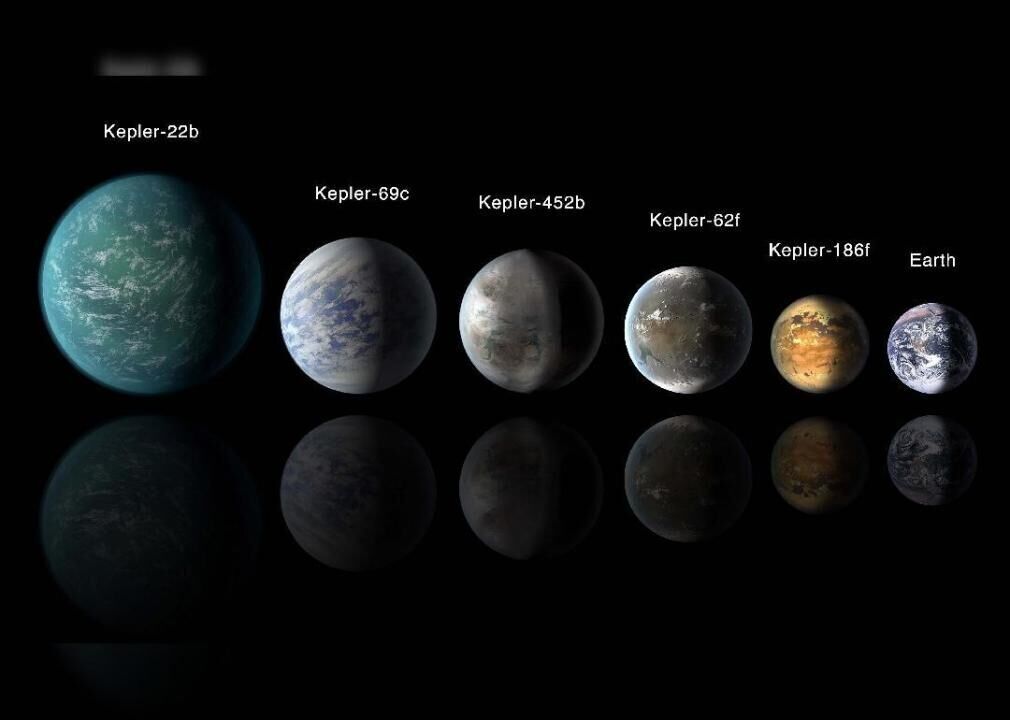
When planets exist beyond our solar system and orbit a star other than the sun, they are called an exoplanet. Exoplanets are extremely hard to see, as they are often hidden by the glare of the star they orbit. Because of that, the first exoplanet was not recognized until 1992.
[Pictured: Kepler's exoplanet discovery.]
#20. Fermi paradox

Named after Italian-American physicist Enrico Fermi, the Fermi paradox is a theory using statistical analysis to postulate why we have yet to see signs of life on other planets within our galaxy. The paradox assesses the likeliness that there are similar planets to Earth within the Milky Way, and likely have the ability to support life, yet no signs of life have been found which means it’s a paradox.
[Pictured: Enrico Fermi, Italian-American physicist, received the 1938 Nobel Prize in physics.]
#21. Galaxy

We all know that we live in the Milky Way galaxy, but what exactly is a galaxy? A galaxy is a wide-ranging mix of dust, gas, stars, and various solar systems brought together by a singular gravitational pull.
[Pictured: The perfectly picturesque spiral galaxy known as Messier 81, or M81, looks sharp in this new composite from NASA's Spitzer and Hubble space telescopes and NASA's Galaxy Evolution Explorer.]
#22. Gamma-ray burst

A gamma-ray burst is the most violent type of explosion in the universe. The explosion itself emits more energy in 10 seconds than the sun will emit in its lifetime. When it happens, it’s the brightest source of light in the observable universe. Satellite evidence suggests gamma-ray bursts are the result of matter collapsing into black holes.
[Pictured: Illustration of a gamma-ray burst.]
#23. Gravity

Based on the Latin word for “weight,” gravity is a natural phenomenon where things with mass or energy are drawn toward its center. The force of gravity is what keeps us planted on Earth’s surface and also keeps the Earth orbiting the sun.
[Pictured: Stephen Hawking (center) enjoys zero gravity during a flight aboard a modified Boeing 727 aircraft.]
#24. Hypergalaxy

A hypergalaxy consists of one large dominant galaxy surrounded by various smaller tertiary galaxies. The Milky Way and our neighboring Andromeda galaxies are both hypergalaxies.
[Pictured: The Milky Way, an example of a hypergalaxy.]
#25. Light-year

A light-year is as simple a concept as its name suggests. It is an astronomical distance that measures the distance that light travels in a year. One light-year roughly equates to 6 trillion miles.
#26. Magellanic clouds

Understanding Magellanic clouds has become a propelling source of understanding distant galaxies. They consist of two irregular galaxies that orbit the Milky Way. Orbiting about 200,000 light-years away, the Magellanic clouds are formed by the Large Magellanic Cloud and the Small Magellanic Cloud.
[Pictured: Small Magellanic Cloud galaxy captured by NASA's Great Observatories.]
#27. Magnitude

Magnitude refers to a mathematical measurement for something's size or extent in comparison to other similar objects. In astronomy, magnitude is a unitless system used to measure the varying degrees of brightness of objects in the sky. Greek astronomer Hipparchus introduced the concept of magnitude for classifying stars in 129 B.C., referring to the brightest stars in the sky as "first magnitude."
[Pictured: This is a low-resolution version of the skymap. The threshold magnitude is 3.0 so the Milky Way is very faint.]
#29. Milky Way

The Earth’s galactic home, the Milky Way is a spiral galaxy that is constantly rotating. The Milky Way contains a high amount of dust and gas wrapped around the central galactic bulge. The galactic bulge contains a dense amount of dust, gas and stars. And within that bulge, exists a large black hole (see slide #8). Our solar system lies about 30,000 light-years from the galaxy’s center.
[Pictured: The Milky Way captured by NASA's Spitzer Space Telescope.]
#30. Moon

The moon is a heavenly body that orbits the Earth and happens to be the easiest object to spot in the night sky. As the moon orbits our planet, we see it go through “phases,” where at different times different proportions of the moon’s surface are visible. These phases have guided time since the beginning of humanity. The calendar month roughly replicates the moon’s orbit of the Earth.
[Pictured: Moon's north pole assembled from 18 images captured by Galileo's imaging system.]
#31. Nebula

A nebula is a large cloud of dust and gas in space that is produced when a star dies. The gas and dust eventually clump together into a mass large enough to form its own gravity. Nebulae can also be places for new stars to form and are sometimes referred to as “star nurseries.”
[Pictured: The Seagull nebula.]
#32. Nebular hypothesis

The Nebular hypothesis is the most widely accepted theory of how our solar system was born. The theory itself was born during the Scientific Revolution from the 16th to18th centuries. The theory’s essence states that our solar system was birthed from a nebula billions of years ago. The theory has also been applied to how all stars came to be.
[Pictured: The nebular hypothesis of Laplace, 1882.]
#33. Neutron star

Neutron stars are small, but very dense objects that are birthed by the explosive death of a giant star. Neutron stars can exist in two states. The first is a pulsar, which emits a narrow radiation beam. The second is a magnetar, which has a powerful magnetic field that has the force to distort atoms.
[Pictured: Artist's illustration of an 'isolated neutron star.']
#34. Oort Cloud

Named after astronomer Jan Oort whose theory about a cloud comprising a shell of icy objects existing beyond the Kuiper Belt, or the region that exists in our solar system beyond Neptune, could be responsible for the long-term comets visible from Earth (like Halley’s). The cloud is theorized to comprise the remains of disc materials of planets and the sun.
[Pictured: This artist's concept puts solar system distances in perspective.]
#35. Orbit

In short, an orbit is the gravitationally curved trajectory of an object in space. In other words, an orbit is the circular motion in which objects in space travel due to gravity’s pull. For example, the moon orbits around the Earth and the Earth orbits around the sun in a circular motion. An object that orbits another is called its satellite.
[Pictured: The International Space Station orbits above Earth.]
#36. Parallax

Measuring using parallax involves estimating the distance of nearby celestial objects by measuring movement against more distant celestial objects. This method is often used when measuring distances of neighboring stars, called stellar parallax.
[Pictured: Artist's concept of parallax.]
#37. Quasar

Quasars are large distant objects in space that are powered by large, powerful black holes. They tend to shine so brightly that their light eclipses the old galaxies that they exist within. They are capable of emitting thousands of times more energy than the Milky Way emits.
[Pictured: Artist's concept of a quasar.]
#38. Red giant

A red giant is a star that is reaching its final days and approaching death. If a star has turned into a red giant, the star is in the last states of its stellar evolution and expands. Our own sun will eventually expand and turn into a red giant—but not for a few billion years.
[Pictured: Image shows the "bow shock" of a dying star named R Hydrae, or R Hya, in the constellation Hydra.]
#39. Red shift

Red shift and blue shift explain how light changes wavelength as objects in space move closer or farther from each other. As an object moves away from us, the light is shifted towards the red end of the color spectrum. In turn, as it moves closer, the light shifts towards the blue end of the spectrum. Along with blue shift, red shift is hugely valuable in understanding the universe’s expansion.
[Pictured: Image of what could be the most distant galaxy ever seen. The small galaxy's starlight has been stretched into longer wavelengths, or "redshifted," by the expansion of the universe.]
#40. Solar system

A solar system is a gravitationally bound system of a sun and the objects that orbit it. That includes the bodies that orbit the objects orbiting the sun. For example, our solar system contains the sun, the planets that orbit it, as well as moons and other objects that orbit them.
[Pictured: Stylized rendition of our solar system.]
#42. Spaghettification

Sometimes referred to as the “noodle effect,” Spaghettification is when the extreme tidal forces stretch out objects to be long and thin like a noodle. This effect can also be caused by the immense gravitational pull of a black hole.
[Pictured: Illustration showing what spaghettification will do to an astronaut entering a small black hole's event horizon.]
#43. Star

Other than serving as beautiful guiding lights in our sky, stars are astronomical objects that are composed of gas that pulls itself together with its own gravitational pull. Nuclear fusion at the star’s core creates the light that stars emit.
[Pictured: Star from the Lizard constellation.]
#44. Star cluster
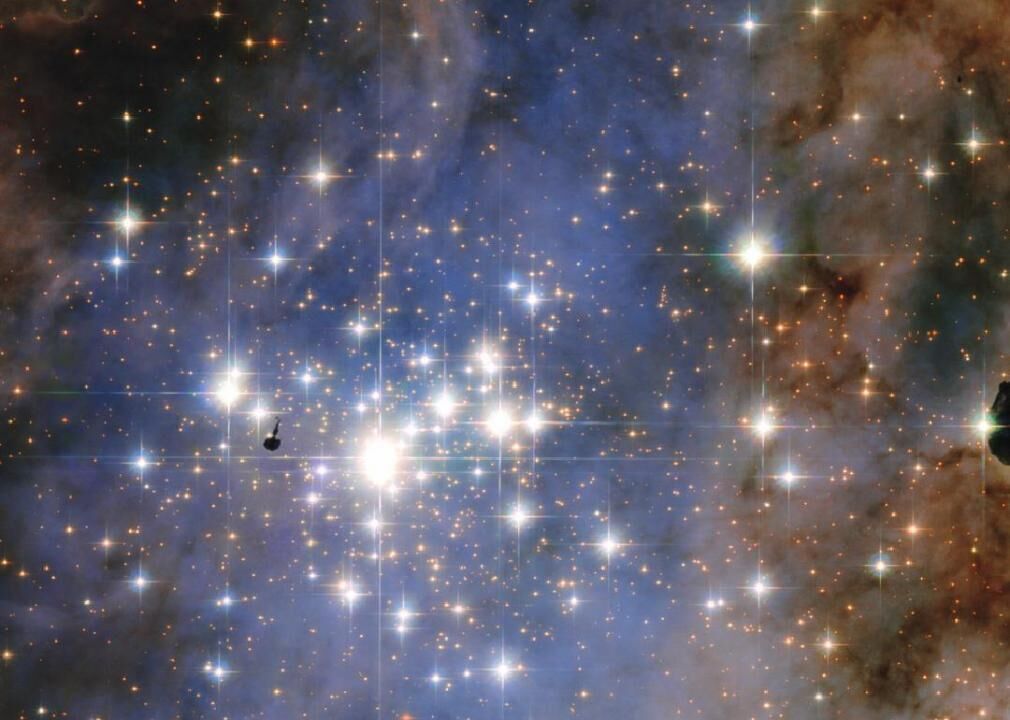
In the same way that planets can be gravitationally bound to the sun, causing them to orbit it, stars can also cluster together due to gravity. Two types of star clusters can be determined: globular clusters and open clusters. Globular clusters are tight clusters of thousands of older stars, whereas open clusters are made up of a few hundred very young stars.
#45. Supernova
A supernova is the largest explosion that can be seen with the human eye. A supernova occurs as the last step of a dying massive star that emits an extremely bright light. This occurs in the death of a star at least five times the mass of our solar system’s sun.
[Pictured: Data combined from four different space telescopes to create a multi-wavelength view of a supernova called RCW 86.]
#46. Telescope

A telescope is the signature tool of astronomers to see far objects out in space in further detail. Today, telescopes are designed with curved mirrors that gather light from the sky and concentrates it so that far away objects are visible.
[Pictured: The Hubble Space Telescope as seen from the departing Space Shuttle Atlantis.]
#47. Theory of relativity

The theory of relativity was developed by Albert Einstein in 1905 and includes both theories of special relativity and general relativity. The theory determines that the laws of physics are the same for all non-accelerating observers and was monumental in introducing a framework for space and time.
#48. Tides

Tides are the rise and fall of sea level that is caused by the gravitational pull of the moon and the sun. They are one of the most reliable phenomena in the world. The difference between high and low tide is called the tidal range.
#49. White dwarf

A white dwarf is a relatively small star that is about the size of a planet that is very dense. It is essentially a star that has exhausted all of its nuclear fuel from within. It expels most of its outer material, leaving a white-hot core that cools over the next billion years.
[Pictured: NGC 7293, better known as the Helix nebula. The core of the star is a small, hot, dense remnant known as a white dwarf.]
#50. Universe

And lastly, we have landed at the universe. A loaded definition that has flummoxed scientists for generations, a universe contains billions of galaxies and even more stars along with their planets, moons, asteroids, comets, dust, and gas, all of which exists swirling around in the massive thing we call space.
[Pictured: Deep space images ever captured by the Hubble.]
You may also like: Can you answer these real 'Jeopardy!' questions about space?

Venus was once a planet not too dissimilar to Earth, and if Jupiter hadn't altered its orbit around the sun, it might have been able to support life, according to researchers.

A spacecraft bound for Mercury swung by Venus on Thursday, using Earth's neighbor to adjust its course on the way to the solar system’s smallest and innermost planet.

What makes these showers distinct are the beautiful gas trails left behind that can stretch out for seconds after the meteor itself is gone. Or they can break up into bright fragments.

The research is based on data gathered by NASA's Lunar Reconnaissance Orbiter. Here's what it could mean for future NASA missions.

Philosophers say now is the time to mull over what qualities should grant an artificially intelligent machine moral standing.

The posters, which include elusive dark matter, a deadly gamma ray burst and a "galactic graveyard," are free to download from NASA's site. There's also a playlist that includes the scary sounds of space.

Scientists have digitally rebuilt the brain of a dinosaur, revealing "surprising" insights into its diet and behavior.

A new space telescope will help scientists look back in time at the origin of our universe and the galaxies and planetary systems that have populated it ever since.

The universe may be a little darker after a recent discovery has shown that there could be fewer galaxies populating it.

After hurtling hundreds of millions of miles through space since last summer, three robotic explorers are ready to hit the brakes at Mars. The stakes — and anxiety — are sky high.

Watch live video and follow the latest updates from NASA and other scientists, as the Perseverance rover attempts to land on Mars.

The Ingenuity helicopter survived its first night on the freezing-cold surface of Mars, a major milestone in the rotorcraft's journey ahead of its historic first flight.

A giant star is blinking near the center of our Milky Way galaxy like a stellar beacon, according to new observations by astronomers.

In honor of National Space Day later this week, here's a look at key astronomy and astrophysics terms that are out of this world.

Crystals are part of a larger tradition of metaphysical religions that have a long history in the U.S.

To prepare for World Space Week (Oct. 4-10), here's a list of key astronomy and astrophysics terms that are out of this world.

When an asteroid slammed into Earth 66 million years ago, it wiped out the dinosaurs — and triggered a global tsunami, research shows.

Before summer, 14 more humans could launch from U.S. soil as SpaceX has three missions set to lift off from Kennedy Space Center on Crew Dragons, while Boeing looks to send its CST-100 Starliner up to the International Space Station for the first time with people on board.

Though it may appear far away for those of us down here, it will in fact be near enough for NASA to reach out and touch it.

Shocked St. Patrick's Day revelers posted videos of the surprising sight on social media.

The rocket lifted off late Wednesday night amid fanfare but failed three minutes into flight — far short of orbit.

Northern light enthusiasts got a surprise mixed in with the green bands of light dancing in the Alaska skies: A light baby blue spiral resembling a galaxy appeared amid the aurora for a few minutes.

NASA is forecasting a busy weekend in space, with objects the size of buses, airplanes — and yes, even 18 walruses stacked in a row — but you needn’t change your plans.

They said it's the strongest evidence yet of such a bizarre cosmic pairing, long suspected but never proven.


