

OMAHA -- Partway through counting grains of pollen on a slide Tuesday morning, Dr. Andrew Rorie had already concluded it was going to be a rough day for people sensitive to tree pollen.
People are also reading…
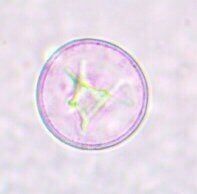
Juniper pollen, at 100 times magnification under a microscope.
10 invasive plants that can also trigger allergies
10 invasive plants that can also trigger allergies

Every spring, many people’s thoughts turn to allergies. Common allergens are plants or weeds known as noxious weeds. Federal, state, and local authorities legally categorize noxious weeds or plants to be deleterious to people, wildlife, and agriculture. Many noxious plants or weeds are also considered invasive, meaning they are not native to the local ecosystem or even native to the U.S.
Humans often spread invasive species, albeit unintentionally. For example, large ships can carry aquatic organisms in ballast water and small boats can carry them on their propellers. Seeds from plants used for ornamental purposes can spread, allowing them to grow in the wild.
Every spring through autumn, plants release tiny pollen grains that fertilize plants of the same species. Most flowering plants that spread their pollen by insects do not cause allergies. Weeds, grasses, and trees are the primary sources of pollen that can cause allergies. An allergy to pollen is called allergic rhinitis, more commonly known as hay fever.
Wyndly compiled a list of 10 invasive species and outlined how they impact seasonal allergies, citing data from the U.S. Department of Agriculture and Invasive Species Atlas. Plants such as ragweed, which is native to the entire continental U.S., are not included.

Johnsongrass

- Scientific name: Sorghum halepense
- Native habitat: Mediterranean region
- Introduced to U.S.: Early 1800s
Johnsongrass is a moderate allergen and was originally introduced in the U.S. as a forage crop. Johnsongrass spreads quickly in different habitats, including forests, fields, and wetlands. It forms dense colonies, which can inhibit the growth of agricultural crops and prevent tree seedlings from taking root. It spreads quickly all times of year, impacting allergies year-round.
Johnsongrass causes millions of dollars in lost agricultural revenue in the U.S. every year by invading crops. For example, it can reduce the yield of sugarcane fields in Louisiana by as much as 50%. It can also serve as the host for insects, fungi, roundworms, and viruses that damage crops.
Russian knapweed

- Scientific name: Rhaponticum repens
- Native habitat: Eurasia
- Introduced to U.S.: Early 1900s
Russian knapweed was accidentally introduced to the U.S. via contaminated alfalfa seeds from the Turkestan region of Central Asia. These plants are members of the daisy family, making anyone prone to daisy allergies also vulnerable to Russian knapweed's pollen.
Russian knapweed invades open land and crowds out native plant species, including forage for animals. This plant can quickly get out of hand, causing infestations that worsen the quality of plants for grazing animals.
Grazing animals usually avoid eating Russian knapweed because of its bitter taste. If eaten in sufficient amounts by horses, Russian knapweed causes a neurological disorder called nigropallidal encephalomalacia, or chewing disease. Horses with chewing disease have difficulties eating, drinking, and swallowing.
Quackgrass

- Scientific name: Elymus repens
- Native habitat: Eurasia
- Introduced to U.S.: 1600s
Quackgrass grows in disturbed open areas, where natural vegetation has been removed to expose the underlying soil. This plant can quickly become an infestation through rhizomes, which involves plant roots invading the soil. Cutting off the grassy tops isn't enough; the plant’s root system has to be eradicated as well. It commonly is found in pastures, roadsides, and gardens. It was introduced in the U.S. by accident, likely via contaminated seeds.
Quackgrass flowers in the early summer, when it spreads pollen and contributes to hay fever. This plant competes with agricultural crops and native plant species. It forms dense brush that limits the regeneration of woody plants and trees. It also inhibits the restoration of croplands and pastures, reducing the availability of soil moisture and important nutrients.
Absinth wormwood

- Scientific name: Artemisia absinthium
- Native habitat: Europe, northern Asia and northern Africa
- Introduced to U.S.: 1840s
Absinth wormwood, also commonly known as mugwort, was originally introduced in the U.S. for use as an antiseptic liniment. This plant begins to grow in late April and early May, not flowering until July or August. Those who suffer from spring and summer seasonal allergies may not be spared from absinth wormwood—especially since this plant is perennial.
The leaves give food a sage-like flavor and are used to make vermouth. Like Russian knapweed, Absinth wormwood is toxic to horses. It also taints the milk of cattle that have eaten it.
Mimosa tree

- Scientific name: Albizia julibrissin
- Native habitat: Iran to Japan
- Introduced to U.S.: 1700s
Mimosa trees are smaller trees, less than 50 feet in height, that often grow with multiple trunks. They can invade any disturbed area, such as stream banks and roadsides. Mimosa trees are difficult to remove because of the long-lived seeds that grow in long pods and sprout in late summer. Native to Asia, mimosa trees were introduced to the U.S. in the mid-1700s. The trees are widely used for ornamental purposes.
Bees and butterflies love mimosa trees, spreading their pollen from one plant to the next. This helps the plant spread and can also release allergens into the air and onto other plants insects pollinate.
Palmer’s amaranth

- Scientific name: Amaranthus palmeri S.Watson
- Native habitat: Southwestern U.S.
- Introduced to U.S.: Reported in Virginia in 1915
Palmer’s amaranth is a severe allergen and is one of the most widespread and economically devastating weeds in the southwestern U.S. The plant’s pollen spreads by the wind, which can aggravate allergies. Palmer’s amaranth likely spreads on the ground through contaminated seeds: Recent infestations in the Midwest were traced to contaminated seeding mixes from the Conservation Reserve Program.
Palmer amaranth thrives in hot weather and tolerates drought well, making it more resistant to extreme weather patterns than most native plants. It affects corn, cotton, and soybean plants. Some populations of Palmer’s amaranth are even resistant to herbicides including glyphosate.
Giant reed

- Scientific name: Arundo donax
- Native habitat: Likely eastern Asia
- Introduced to U.S.: Early 1800's
A prolific pollen producer, giant reed is a moderate allergen and has been introduced worldwide for erosion control, ornamental use, and the production of reed for paper, pulp, and musical instruments. It grows in dense stands, with many plants per acre—replacing native vegetation. This displacement of vegetation causes changes to food resources, and the infestation of giant reed reduces wildlife habitats, including those of amphibians and birds.
The giant reed is a member of the grass family, which is generally considered a significant source of allergies, and releases its pollen between July and October.


