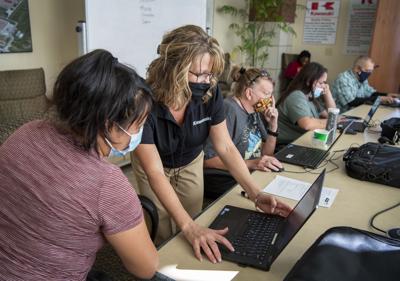
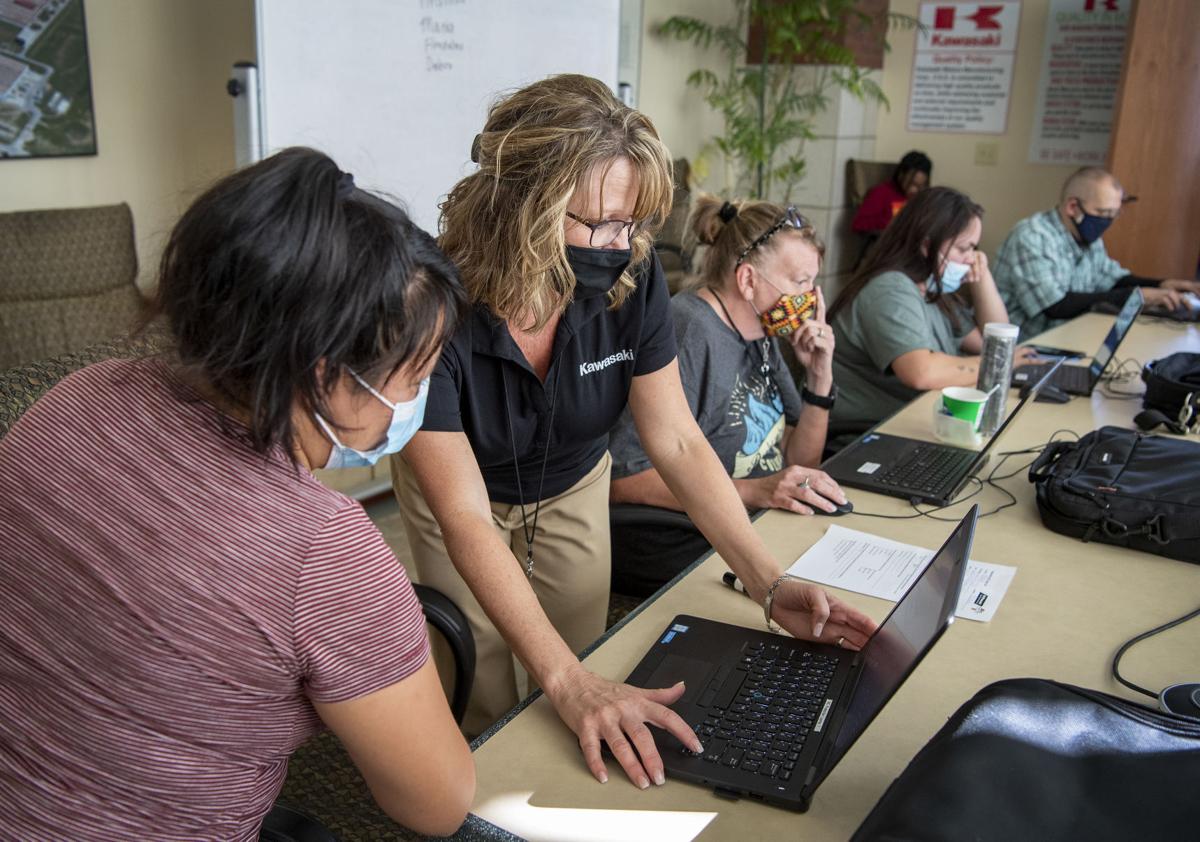
The number of Americans applying for unemployment benefits fell to its lowest level since the pandemic began, a sign the job market is still improving even as hiring has slowed in the past two months.Unemployment claims dropped 36,000 to 293,000 last week, the second straight drop, the Labor Department said Thursday. That's the smallest number of people to apply for benefits since the week of March 14, 2020, when the pandemic intensified, and the first time claims have dipped below 300,000. Applications for jobless aid, which generally track the pace of layoffs, have fallen steadily since last spring as many businesses, struggling to fill jobs, have held onto their workers.The decline in layoffs comes amid an otherwise unusual job market. Hiring has slowed in the past two months, even as companies and other employers have posted a near-record number of open jobs. Businesses are struggling to find workers as about 3 million people who lost jobs and stopped looking for work since the pandemic have yet to resume their job searches. Economists hoped more people would find work in September as schools reopened, easing child care constraints, and enhanced unemployment aid ended nationwide.But the pickup didn't happen, with employers adding just 194,000 jobs last month. In a bright spot, the unemployment rate fell to 4.8% from 5.2%, though some of that decline occurred because many of those out of work stopped searching for jobs, and were no longer counted as unemployed. The proportion of women working or looking for work fell in September, likely because of difficulties finding child care or because of schools disrupted by COVID-19 outbreaks.At the same time, Americans are quitting their jobs in record numbers, with about 3% of workers doing so in August. Workers have been particularly likely to leave their jobs at restaurants, bars, and hotels, possibly spurred by fear of the Delta variant of COVID-19, which was still spreading rapidly in August.Other workers likely quit to take advantage of higher wages offered by businesses with open positions. Average hourly pay rose at a healthy 4.6% in September from a year earlier, and for restaurant workers wage gains in the past year have topped 10%.The number of people continuing to receive unemployment aid has also fallen sharply, mostly as two emergency jobless aid programs have ended. In the week ending Sept. 25, the latest data available, 3.6 million people received some sort of jobless aid, down sharply from 4.2 million in the previous week. A year ago, nearly 25 million people were receiving benefits.The emergency programs provided unemployment payments for the first time to the self-employed and gig workers, and those who were out of work for more than six months. More than 7 million Americans lost weekly financial support when those two programs expired Sept. 6. An extra $300 in federal jobless aid also expired that week.Many business executives and Republican politicians said the extra $300 was discouraging those out of work from taking jobs. Yet in about half the states, the additional checks were cut off as early as mid-June, and those states have not seen faster job growth than states that kept the benefits.Additional reporting by The Associated Press
People are also reading…
The states where the most people worked remote because of COVID-19
States Where the Most People Worked Remote Because of COVID-19

Photo Credit: thanmano / Shutterstock
The widespread turn to remote work was one of the most prominent effects of the COVID-19 economy. When the pandemic struck in the spring of 2020, organizations across the U.S. and the world adapted quickly to accommodate their distributed teams. Fueled by the need to abide by social distancing protocols, employers accelerated the trend toward remote work, making new digital collaboration technologies ubiquitous among the professional class.
This summer, as vaccines became widely available, employers’ stances toward remote work have begun to look more complicated. While some businesses have made hybrid and remote work permanent, a recent survey by the Society for Human Resource Management found that 72% of supervisors would prefer their employees to be back in the office, believing remote arrangements to be worse for networking and collaboration. But as the Delta variant continues to spread this fall, more offices may find themselves delaying or reversing their plans to resume in-person work. Meanwhile, data shows that employees would like to work remotely, at least some of the time, with 55% of employees saying they’d like to be remote at least three days a week.
About 30% of adults live in households with 1 remote worker

Even though remote workers currently constitute a minority of the U.S. workforce, recent data from the U.S. Census Bureau’s Household Pulse Survey, shows that approximately 30% of adults live in a household with at least one remote worker. This data was collected from mid-April—when vaccines first became available to all adults—through early July—when cases began to rise again. Despite a minority of adults working from home today, certain experts predict a dramatic rise in the coming years, where more than 70% of the workforce could be remote at least one week a month by 2025.
Beyond some employers’ preferences for having workers in the office, the larger reason why remote workers represent a relatively small portion of the workforce is that many professions and industries simply cannot operate remotely. Workers in major industries like food and hospitality, retail, and manufacturing are among those who must be physically present to work.
Higher income households were more likely to shift to remote work

This fact also has the effect of reflecting income inequality between remote and in-person workers. The Household Pulse Survey data shows a strong correlation between median household income and the percentage of adults in households with a remote worker. This suggests that many higher-earning professions easily moved online, while most low-wage hourly jobs could not do so. This divide has created even greater burdens on lower-earning Americans, as the Household Pulse Survey data also reveals a correlation between being unable to work remotely and having difficulty paying household expenses. With the recent expiration of government supports like the eviction moratorium and expanded unemployment benefits, this could make low-wage workers’ financial position even more tenuous as the Delta variant continues to spread.
MD and MA reported the most people teleworking due to COVID-19

The divergence across industries and income levels also means that remote work is unevenly distributed by geography. Many of the states that have the most households with members working remotely also have more workers in white collar jobs with higher earnings. The two states that had the greatest share of adults in households with a remote worker due to COVID—Maryland at 37.4% and Massachusetts at 37%—also have the highest median household incomes at $86,738 and $85,843, respectively. In contrast, Mississippi has both the lowest share of households with a remote worker at 11.1% and the lowest median income at $45,792. This disparity is also likely due to a higher number of in-person jobs in Mississippi, where demand is high for jobs in food, retail, production, and transportation.
To determine the states where the most people worked remotely because of COVID-19, researchers at Teamflow used data from the U.S. Census Bureau’s Household Pulse Survey to calculate the percentage of adults in households where at least one adult worked from home because of the coronavirus pandemic in the past seven days, averaged over the survey weeks during which this question was asked: April 14, 2021 through July 5, 2021. Notably, this only includes those who worked remotely because of the pandemic, and not those that would have done so regardless. In the event of a tie, the state with the higher number of adults in these households was ranked higher.
Here are the states where the most people worked remotely because of COVID.
15. Oregon

Photo Credit: Bob Pool / Shutterstock
- Percentage of adults in households with a remote worker: 27.5%
- Total adults in households with a remote worker: 905,959
- Percentage of adults in households with expected income loss: 13.9%
- Percentage of adults in households with difficulty paying expenses: 24.2%
- Median household income: $67,058
14. Delaware

Photo Credit: Jon Bilous / Shutterstock
- Percentage of adults in households with a remote worker: 27.8%
- Total adults in households with a remote worker: 211,559
- Percentage of adults in households with expected income loss: 10.0%
- Percentage of adults in households with difficulty paying expenses: 24.2%
- Median household income: $70,176
13. New Hampshire

Photo Credit: Sean Pavone / Shutterstock
- Percentage of adults in households with a remote worker: 28.4%
- Total adults in households with a remote worker: 304,889
- Percentage of adults in households with expected income loss: 7.6%
- Percentage of adults in households with difficulty paying expenses: 21.2%
- Median household income: $77,933
12. New York

Photo Credit: Victor Moussa / Shutterstock
- Percentage of adults in households with a remote worker: 28.6%
- Total adults in households with a remote worker: 4,141,233
- Percentage of adults in households with expected income loss: 16.1%
- Percentage of adults in households with difficulty paying expenses: 29.5%
- Median household income: $72,108
11. Connecticut

Photo Credit: Sean Pavone / Shutterstock
- Percentage of adults in households with a remote worker: 28.8%
- Total adults in households with a remote worker: 772,712
- Percentage of adults in households with expected income loss: 11.0%
- Percentage of adults in households with difficulty paying expenses: 25.7%
- Median household income: $78,833
10. Illinois

Photo Credit: Oleg Podzorov / Shutterstock
- Percentage of adults in households with a remote worker: 28.8%
- Total adults in households with a remote worker: 2,705,697
- Percentage of adults in households with expected income loss: 12.9%
- Percentage of adults in households with difficulty paying expenses: 25.5%
- Median household income: $69,187
9. California

Photo Credit: yhelfman / Shutterstock
- Percentage of adults in households with a remote worker: 30.2%
- Total adults in households with a remote worker: 8,889,098
- Percentage of adults in households with expected income loss: 18.3%
- Percentage of adults in households with difficulty paying expenses: 28.9%
- Median household income: $80,440
8. Minnesota

Photo Credit: Checubus / Shutterstock
- Percentage of adults in households with a remote worker: 31.6%
- Total adults in households with a remote worker: 1,333,846
- Percentage of adults in households with expected income loss: 9.0%
- Percentage of adults in households with difficulty paying expenses: 19.4%
- Median household income: $74,593
7. Virginia

Photo Credit: Sean Pavone / Shutterstock
- Percentage of adults in households with a remote worker: 31.7%
- Total adults in households with a remote worker: 2,042,937
- Percentage of adults in households with expected income loss: 11.0%
- Percentage of adults in households with difficulty paying expenses: 24.3%
- Median household income: $76,456
6. Washington

Photo Credit: Jeremy Janus / Shutterstock
- Percentage of adults in households with a remote worker: 31.8%
- Total adults in households with a remote worker: 1,867,950
- Percentage of adults in households with expected income loss: 13.1%
- Percentage of adults in households with difficulty paying expenses: 23.3%
- Median household income: $78,687
5. Utah

Photo Credit: Maciej Bledowski / Shutterstock
- Percentage of adults in households with a remote worker: 32.1%
- Total adults in households with a remote worker: 737,725
- Percentage of adults in households with expected income loss: 7.1%
- Percentage of adults in households with difficulty paying expenses: 20.1%
- Median household income: $75,780
4. New Jersey

Photo Credit: Mihai_Andritoiu / Shutterstock
- Percentage of adults in households with a remote worker: 32.7%
- Total adults in households with a remote worker: 2,177,152
- Percentage of adults in households with expected income loss: 14.3%
- Percentage of adults in households with difficulty paying expenses: 26.2%
- Median household income: $85,751
3. Colorado

Photo Credit: Nicholas Courtney / Shutterstock
- Percentage of adults in households with a remote worker: 32.7%
- Total adults in households with a remote worker: 1,457,040
- Percentage of adults in households with expected income loss: 10.9%
- Percentage of adults in households with difficulty paying expenses: 23.6%
- Median household income: $77,127
2. Massachusetts

Photo Credit: ESB Professional / Shutterstock
- Percentage of adults in households with a remote worker: 37.0%
- Total adults in households with a remote worker: 1,937,975
- Percentage of adults in households with expected income loss: 11.9%
- Percentage of adults in households with difficulty paying expenses: 20.6%
- Median household income: $85,843
1. Maryland

Photo Credit: Sean Pavone / Shutterstock
- Percentage of adults in households with a remote worker: 37.4%
- Total adults in households with a remote worker: 1,689,976
- Percentage of adults in households with expected income loss: 12.9%
- Percentage of adults in households with difficulty paying expenses: 25.2%
- Median household income: $86,738